
Speculum Sine Macula
I will put enmities between thee and the woman, and thy seed and her seed.

The Baroque era of art (i.e., the decades roughly between the 1590s and the 1750s) has an unmistakable Catholic character. Coincident with the post-Tridentine Counter-Reformation, the paintings, sculptures and architecture all give roaring witness to the splendid mysteries of the One True Faith which the heretic iconoclasts sought to obfuscate and shield themselves from. In addition to correcting the errors of the Protestants, some artists of this time seized the opportunity to promote theological concepts they felt were underappreciated among their coreligionists. The principal example of this undercurrent was that of the Immaculate Conception.
For centuries prior to this point in history, the Dominicans were pushing the conservative thesis of the “Sanctification of the Blessed Virgin Mary” while the majority opinion, voiced best by the Franciscans and their luminary Duns Scotus, were clamoring for the definition of the Immaculate Conception. In 1571 the revision to the Roman Breviary included the Feast of the Immaculate Conception for December 8 and in 1661 Alexander VII promulgated Sollicitudo omnium ecclesiarum laying out the doctrine of the same, but it would not be until 1854 for Pius IX to declare this a dogma in Ineffabilis Deus. More information surrounding this debate and development can be assessed in this article from the Angelus, this article from the New Liturgical Movement and this episode from the Square Notes podcast.
In this post I’d like to present the standard principles artists employed in representing the Immaculate Conception during the Baroque period alongside recognizable depictions. In two subsequent posts I’ll explore areas of experimentation which led to a surprising and arresting variation on this theme.
Tota Pulchra
In the late Middle Ages an artistic motif began to circulate portraying the Blessed Virgin Mary surrounded by types attributed to her from the Old Testament. These symbols included Porta Caeli (“Gate of Heaven”, Gen. 28:17), Turris Davidica (“Tower of David”, Cant. 4:4), Civitas Dei (“City of God”, Ps. 86:3), Ortus Conclusus (“Enclosed Garden”, Cant. 4:12) and Speculum Sine Macula (“Spotless Mirror”, Wis. 7:26) to name a few. The top of the picture would usually be draped with a banner inscribed with a declaration from God:
Tota pulchra es, amica mea, et macula non est in te.
Thou art all fair, O my love, and there is not a spot in thee.
—Canticle of Canticles iv. 7.
Many will recognize some of these phrases from the Litany of Loreto which was officially promulgated in 1587 by Sixtus V in Reddituri. The title Regina sine labe originali concepta (“Queen conceived without original sin”) was not included until after the 1854 declaration of the dogma, though some local concessions were granted 15 years prior. The Tota Pulchra continued into the Baroque era and its constituent elements would be recycled in what would eventually become the Immaculate Conception.
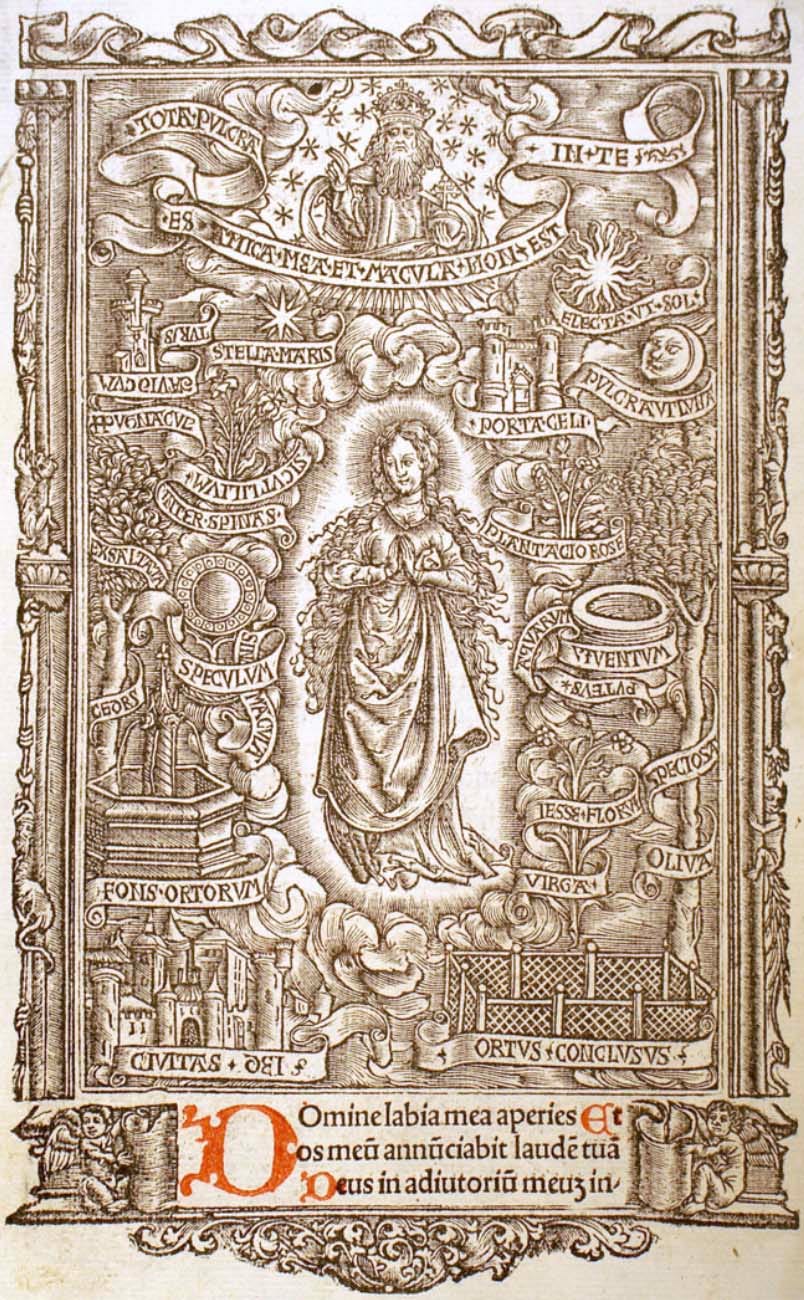
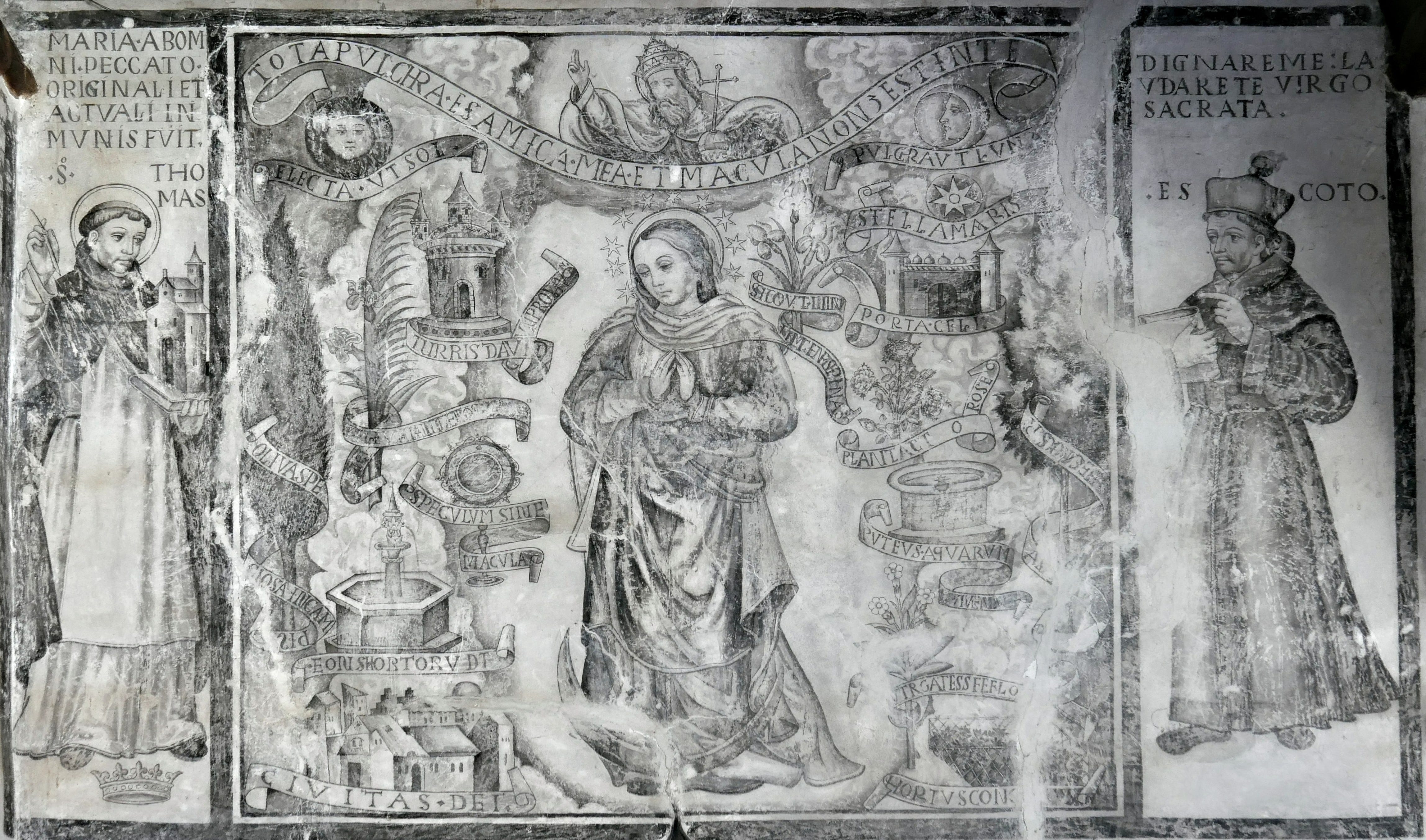
_en_el_Exconvento_de_San_Miguel_Arc%C3%A1ngel,_Huejotzingo_(61260).jpg)
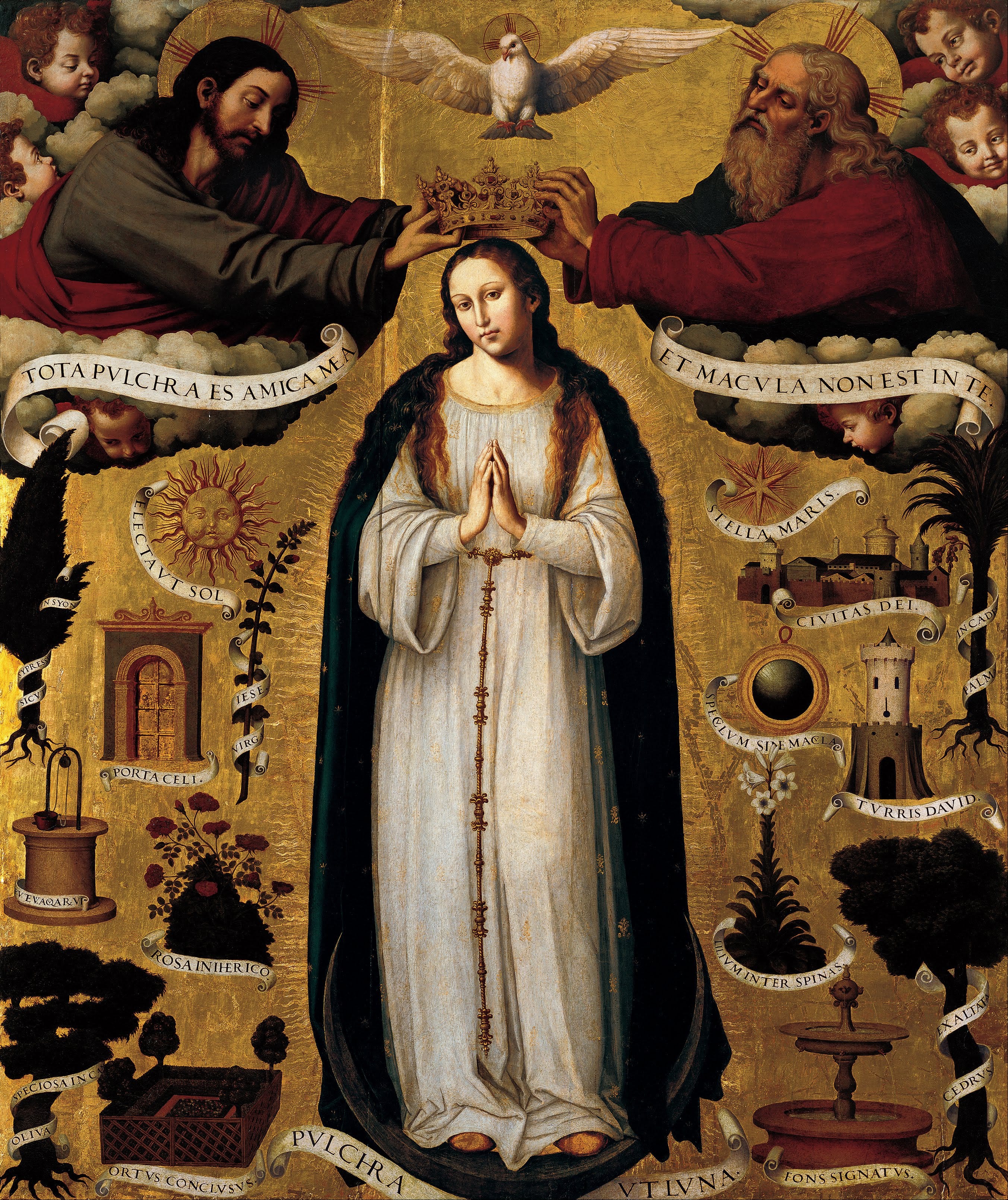

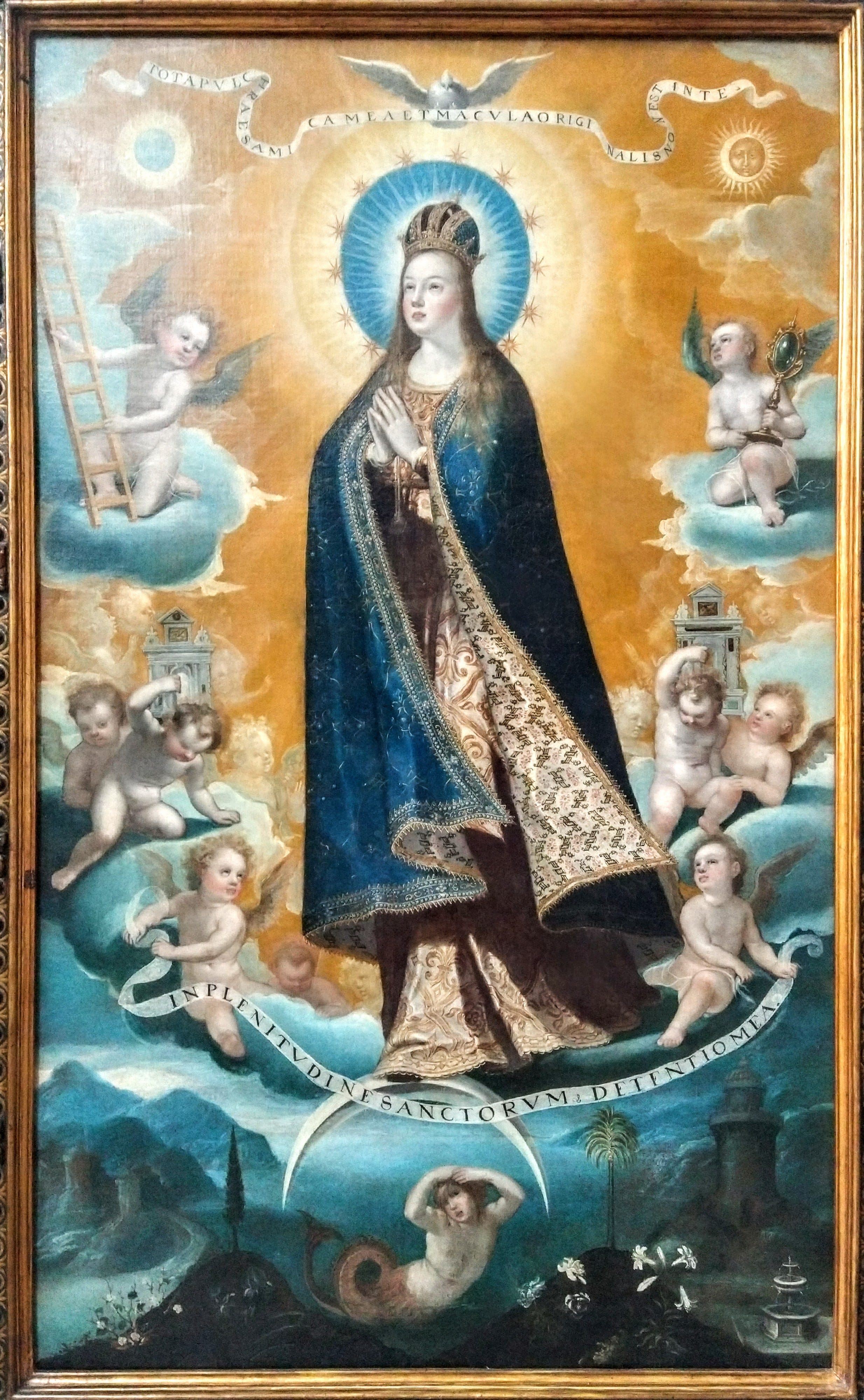
_de_Baltasar_de_Echave_Ib%C3%ADa_en_S%C3%ADmbolo_y_Reino_03.jpg)
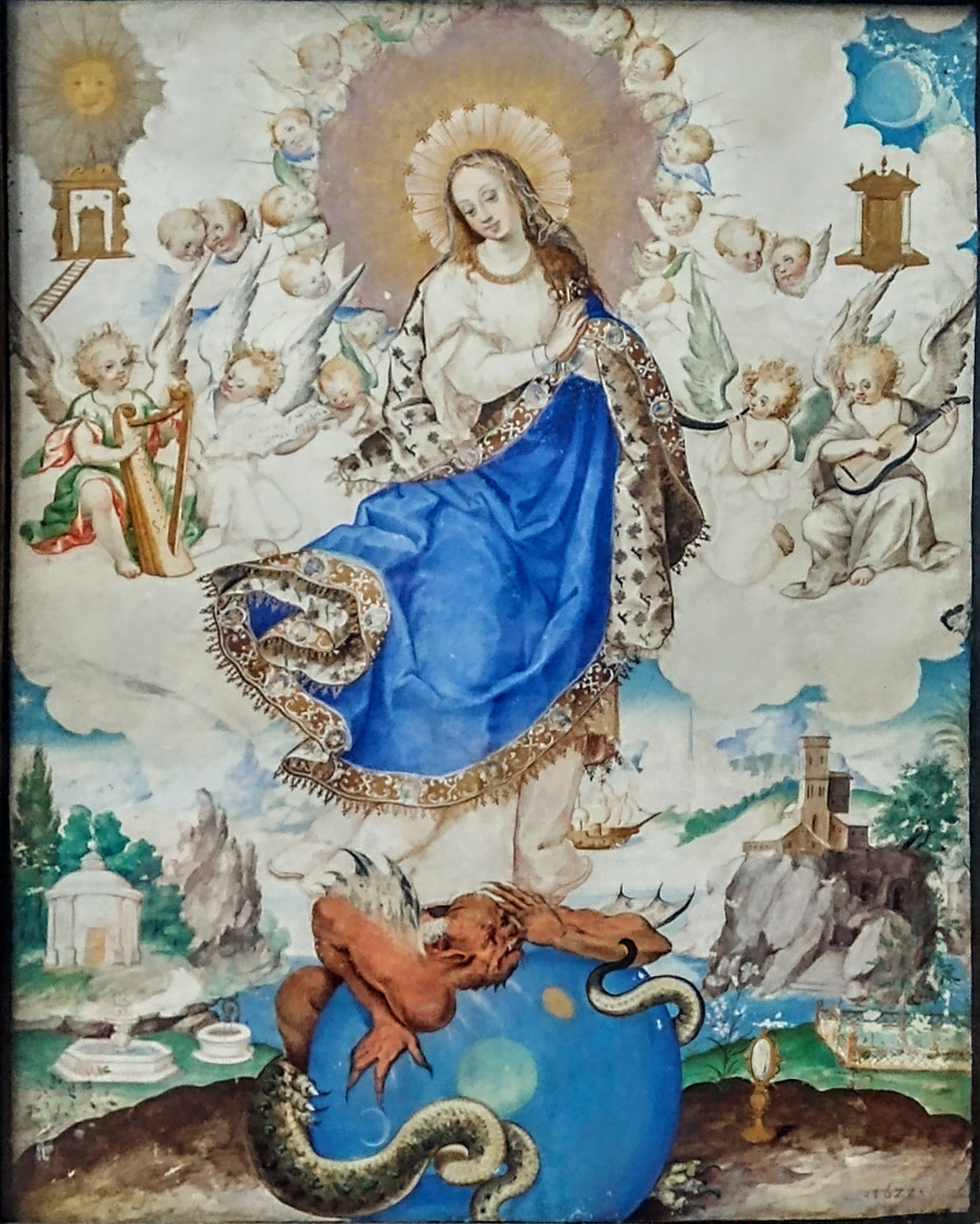

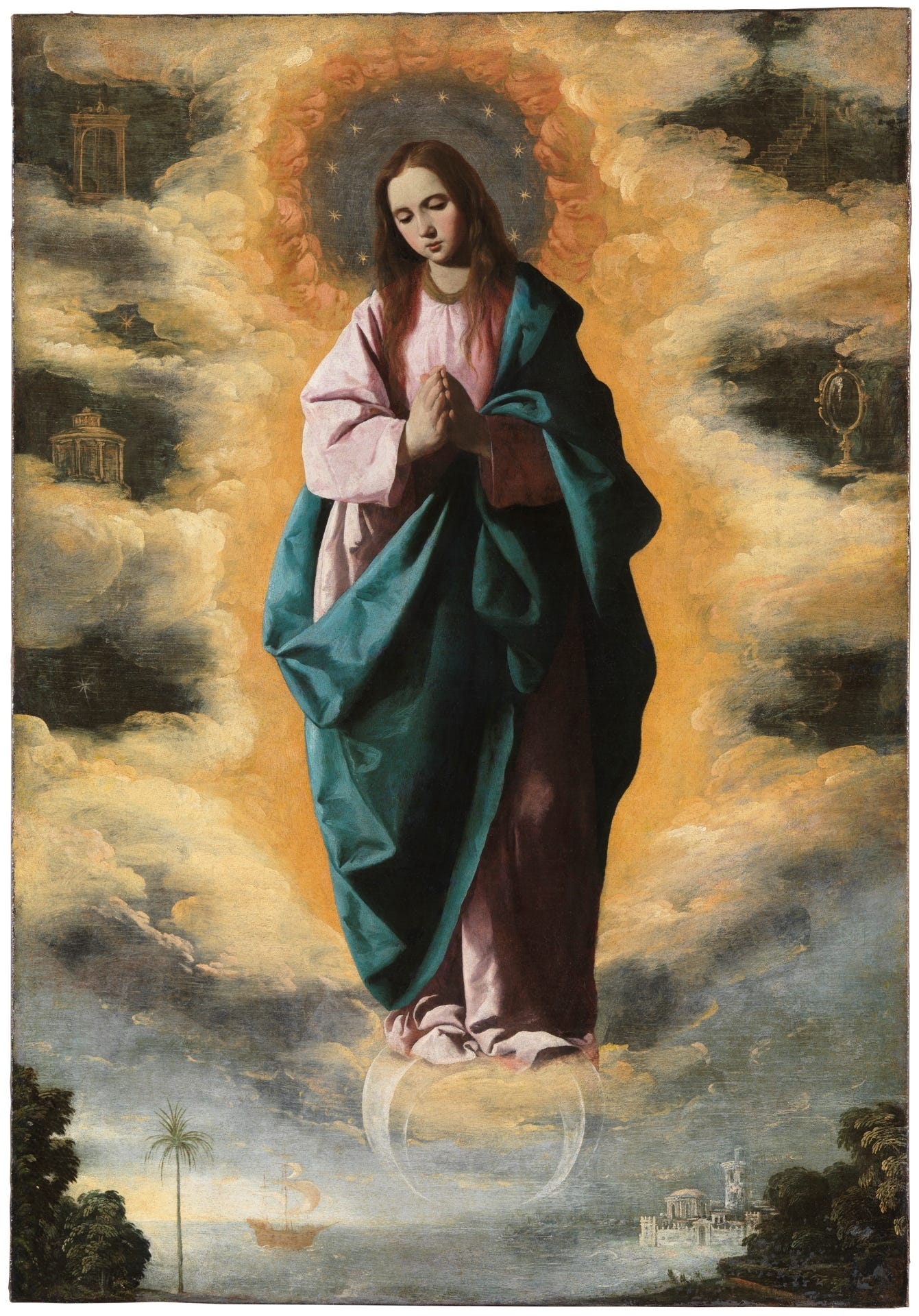
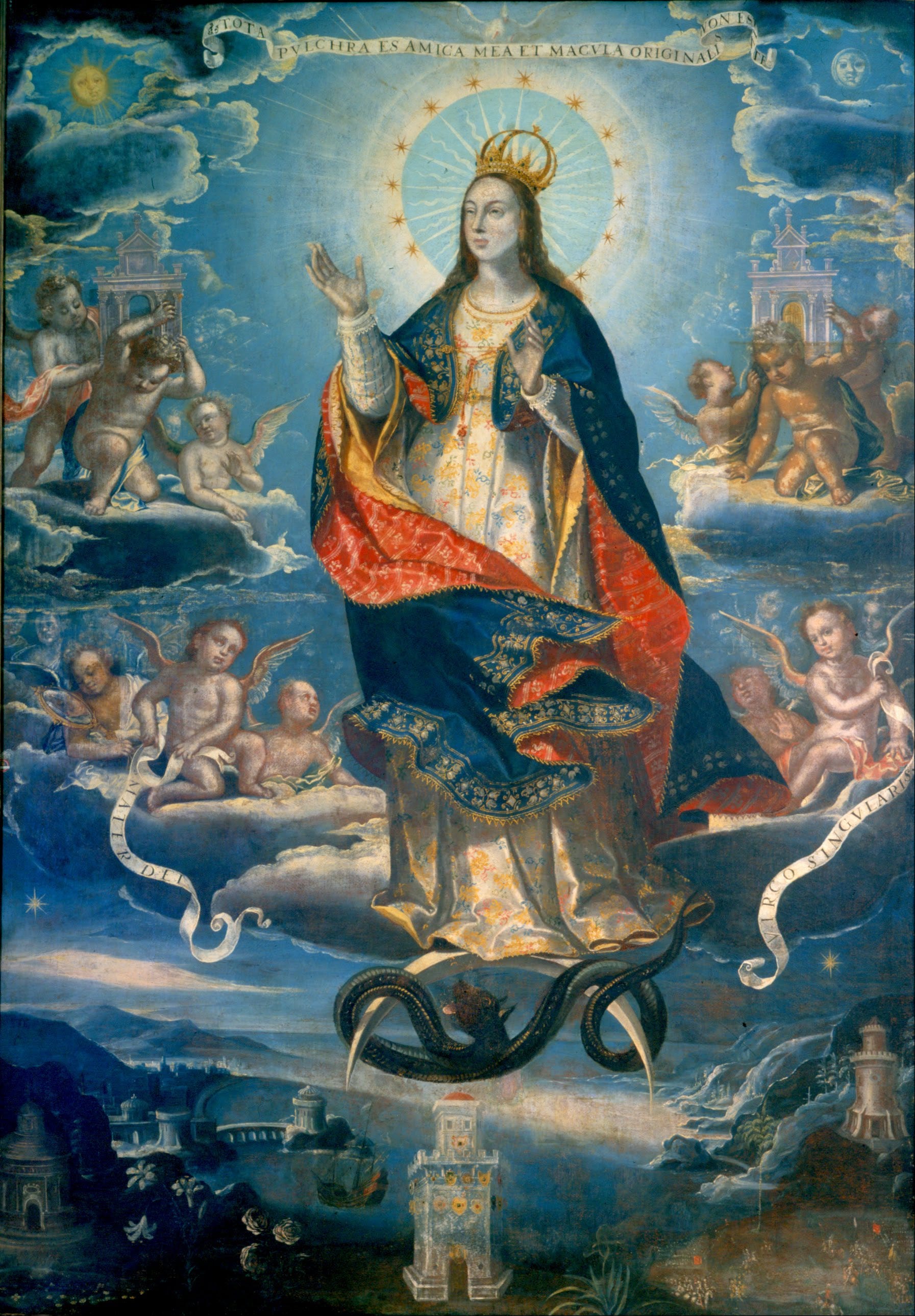

Immaculate Conception
As Mrs. Henry Jenner writes in Our Lady in Art (1910), pp. 5–10:
By the early seventeenth century we get the old idea of the sanctification of Mary fully developed into the complete acceptance of the doctrine of the Immaculate Conception, and a wholly new class of pictures arose. […]
The idea expressed in the pictures of the Immaculate Conception is, so to speak, Mary as she existed from all ages in the mind of the Eternal Father. She is the supreme excellence of Humanity, the highest point touched by the human race. As there is no question of age in eternities such as souls, Mary is represented at the perfection of bodily age, that condition in which it is permissible to believe our glorified bodies will exist after the Resurrection, when growth has ceased, and no decay set in, that one moment of perfect poise between advance and retrogression.
Pacheco, who was art censor for the Inquisition in 1649, laid down rules in his Arte della Pintura for painters to follow. […]
The best artists have represented Mary in the first bloom of young womanhood, occasionally as a child, but this is not so orthodox a conception. The description in the Apocalypse of the woman clothed with the sun and having the moon under her feet and a crown of stars, is held to be a description of what might be called the essence of Mary, the consummation of the second Eve, who undoes the work of the first Eve.
Idealism can go no farther in art than the portraying of this mystery, for the pictures are not of Mary as she was at any one moment of her beautiful girlhood, but Mary, as God’s perfected work, as it exists in His Eternal Conception.
Murillo is the painter par excellence of these highly idealistic pictures. The doctrine has ever been a favourite one in Spain, and its great painter placed no fewer than twenty-five different versions of his vision on canvas. In his great picture at Madrid [La Inmaculada Concepción de El Escorial], where Mary is upborne by angels, she really seems to float above the world and to be rising up to that Beatific Vision, towards which her lovely face is set. […]
It is in Spanish art we find the most beautiful, intelligible, and attractive pictures of this mystery, and the most theologically correct. At the time when this doctrine was most popular the decline of religious feeling in Italy produced pictures more sentimental than devotional, and more concerned with the problems of foreshortening and anatomy than with doctrinal significance.
For further reading, Omnes Magazine has an excellent article on this artistic movement in general and SmartHistory has a spectacular lesson diving deep into Murillo’s most famous Immaculate Conception, Los Venerables. Hopefully, too, a full-size copy of the latter is still on display for tourists at Mary, Queen of the Universe in Orlando, Florida.
I’ll close this first part with a selection of paintings from the nearly 150 Immaculate Conceptions in Wikidata followed by, if I can be indulged, an English translation of Francisco Pacheco’s influential chapter on guidelines for painting this august subject.
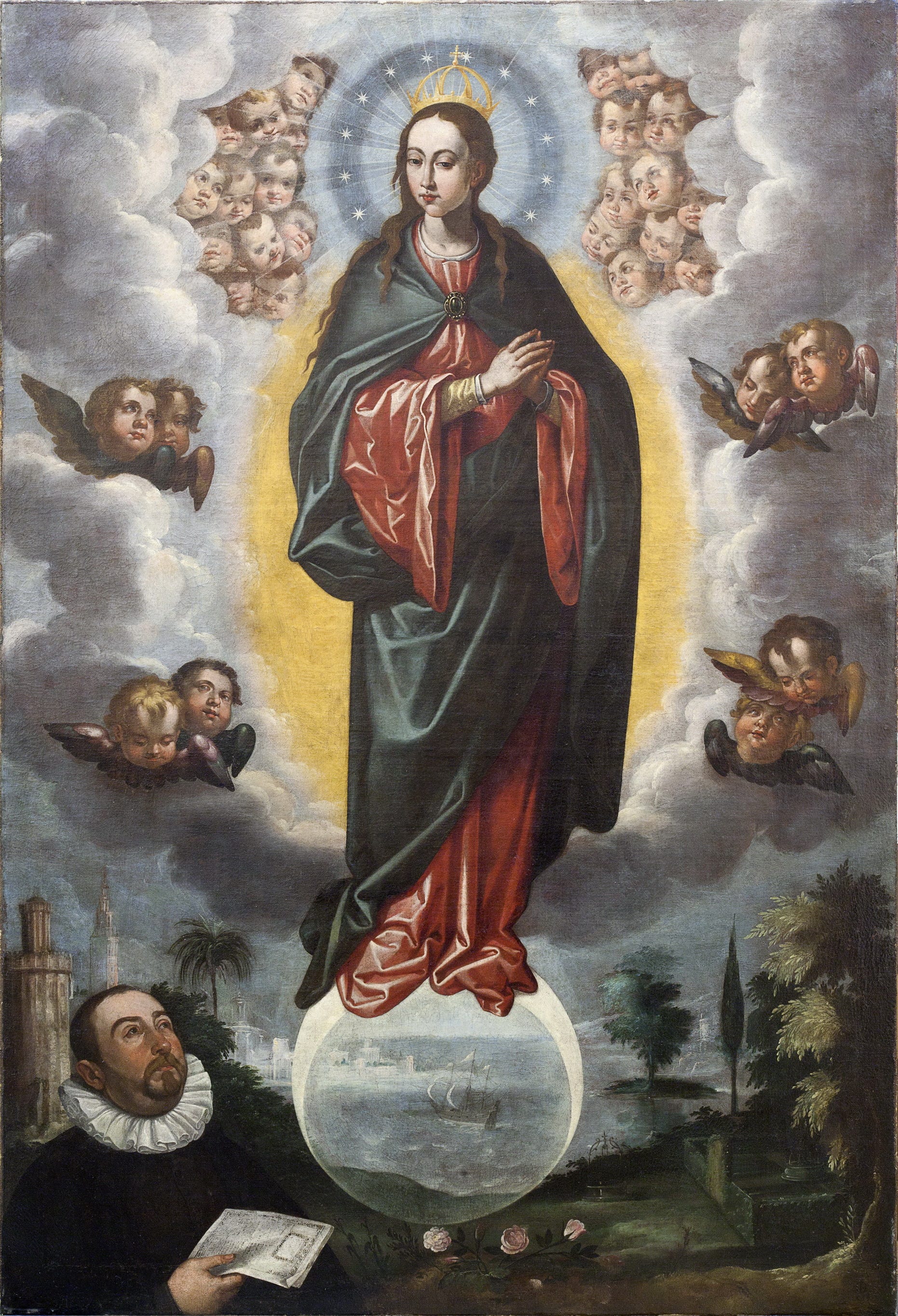
.jpg)
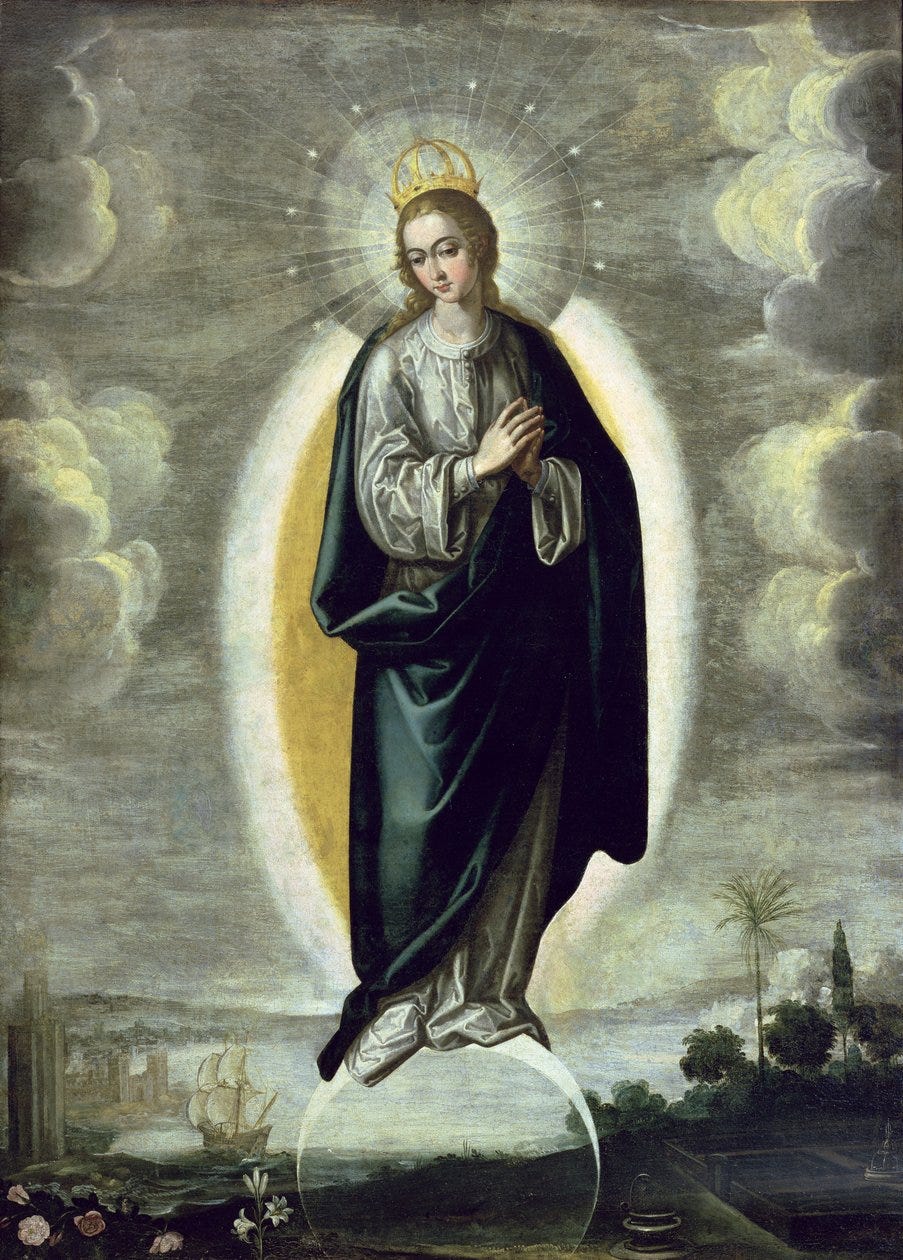
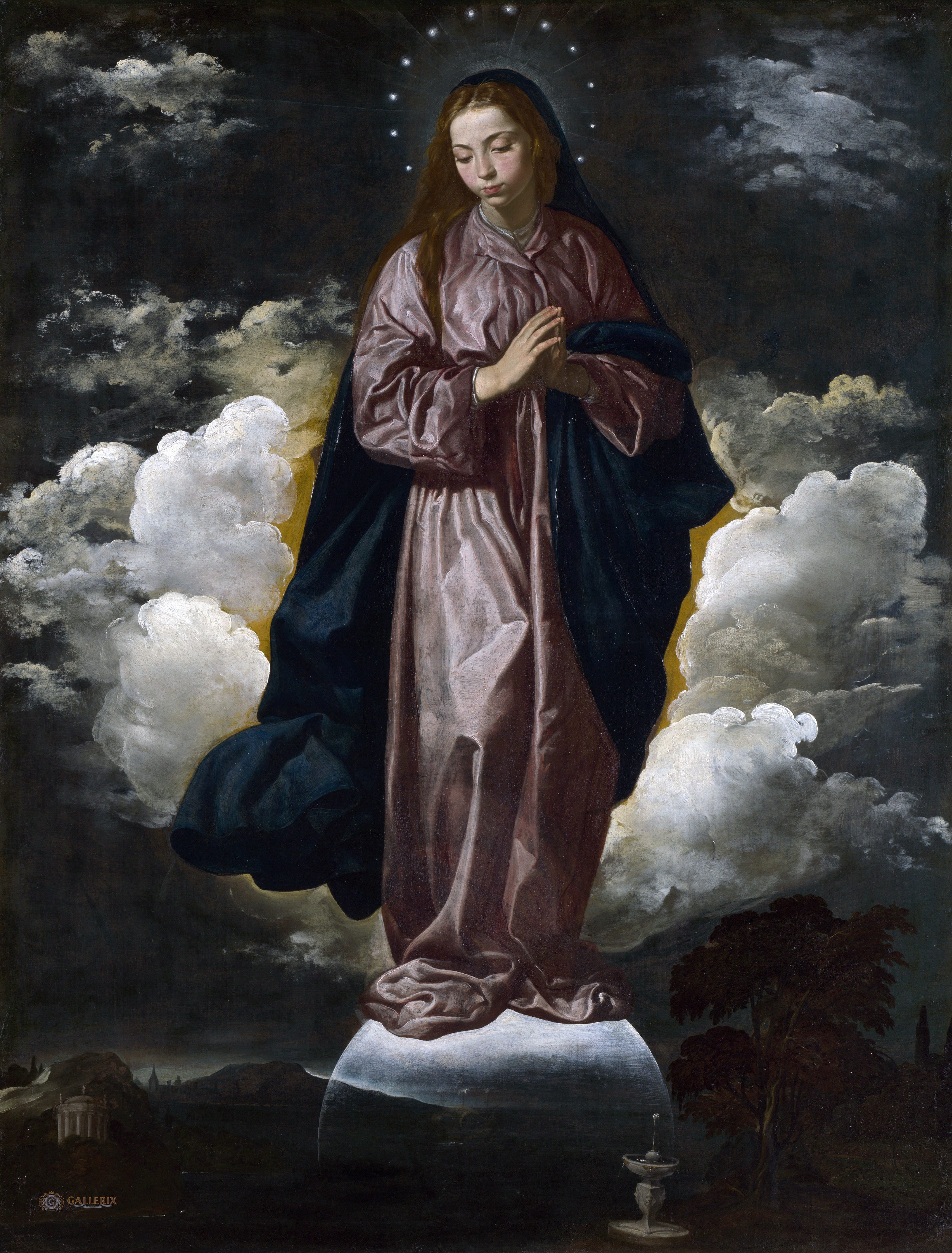
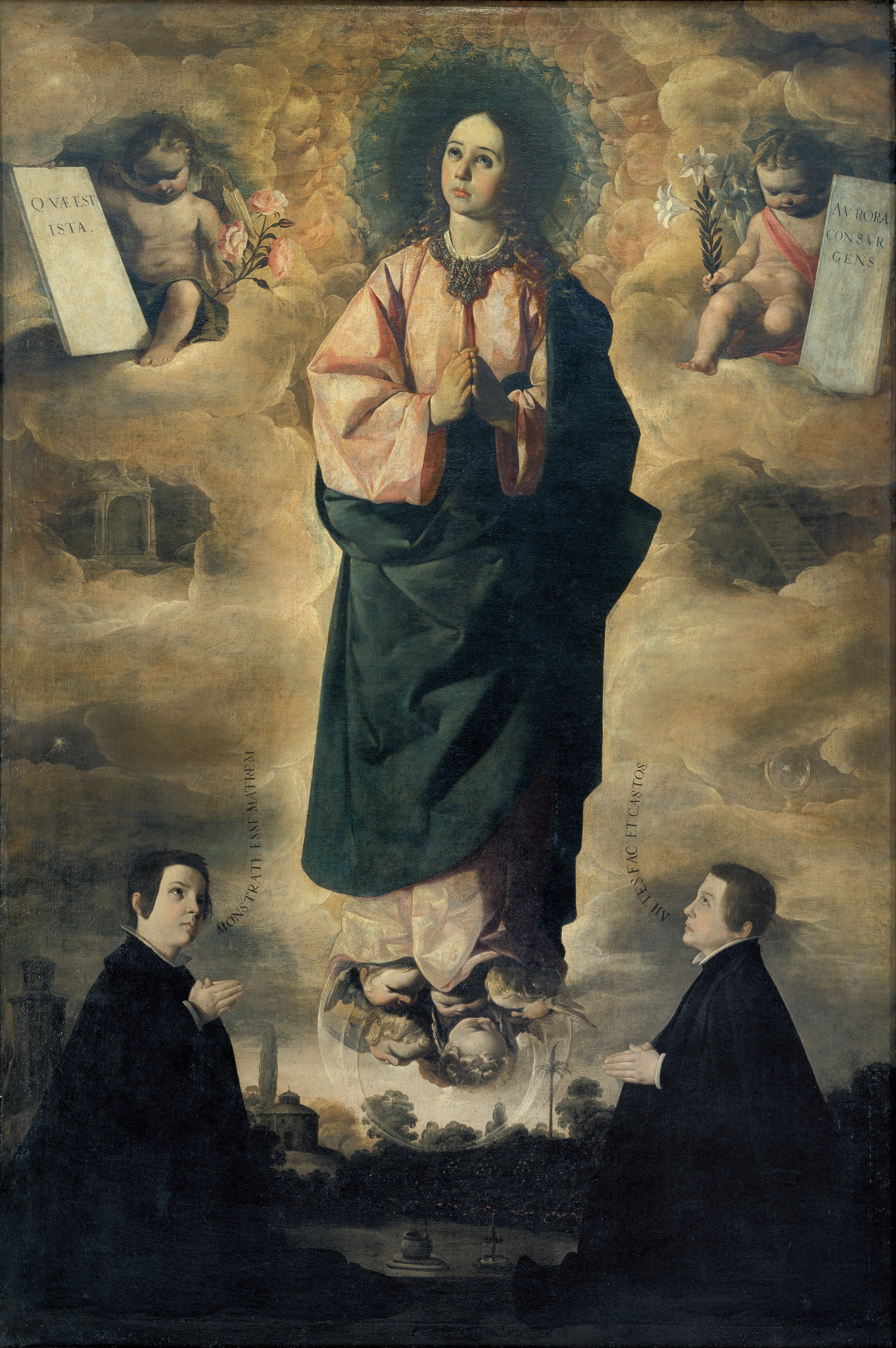
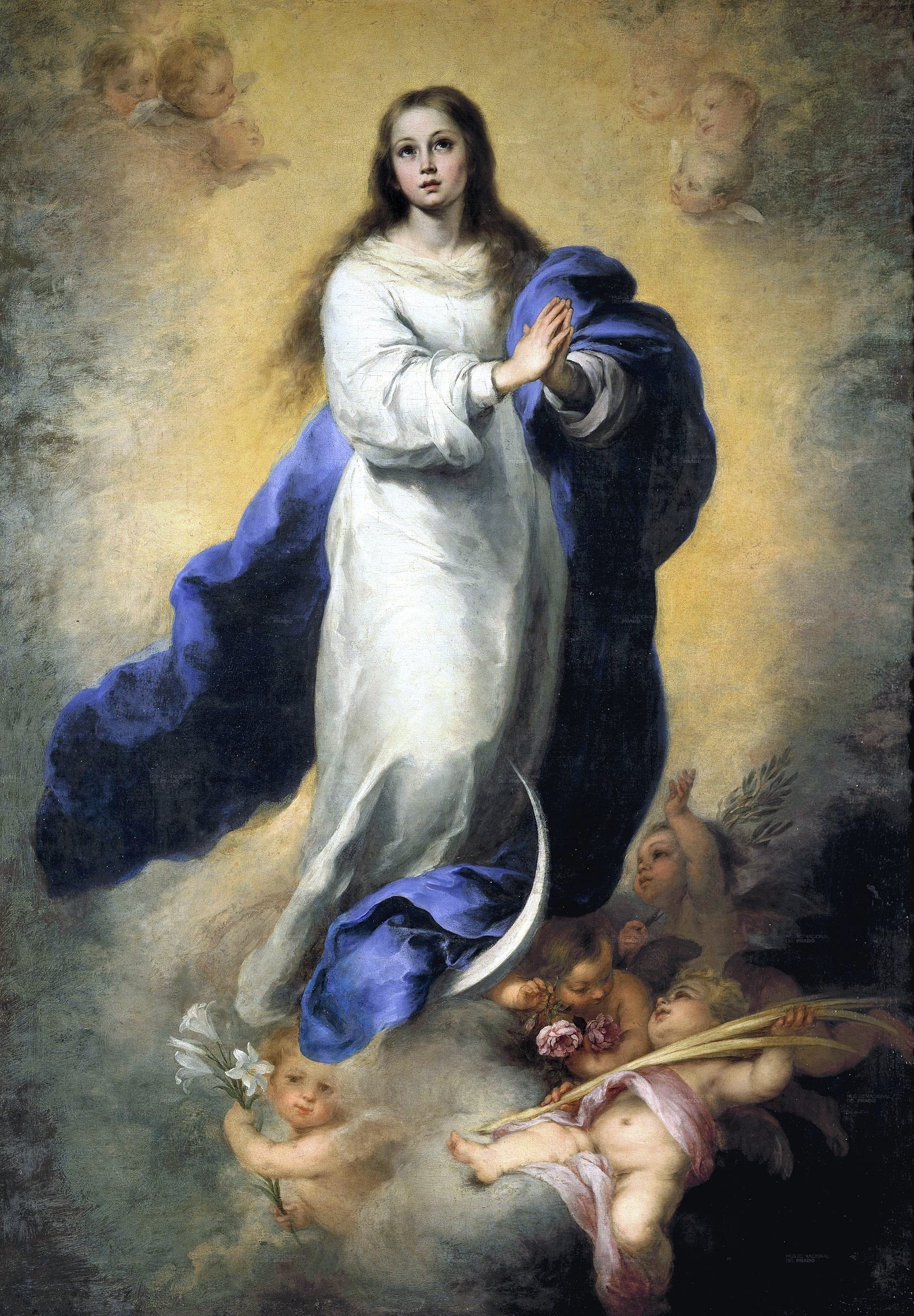
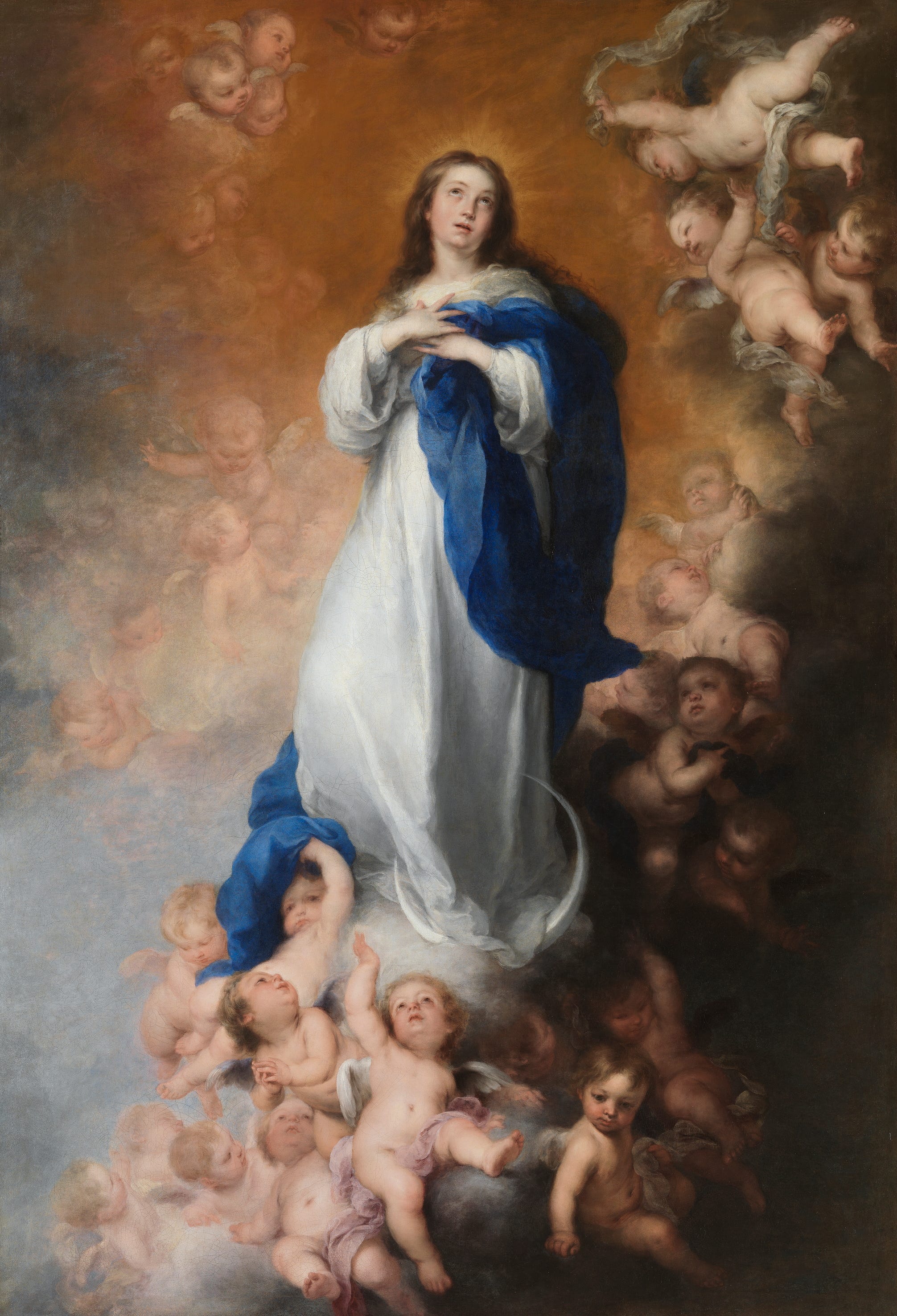
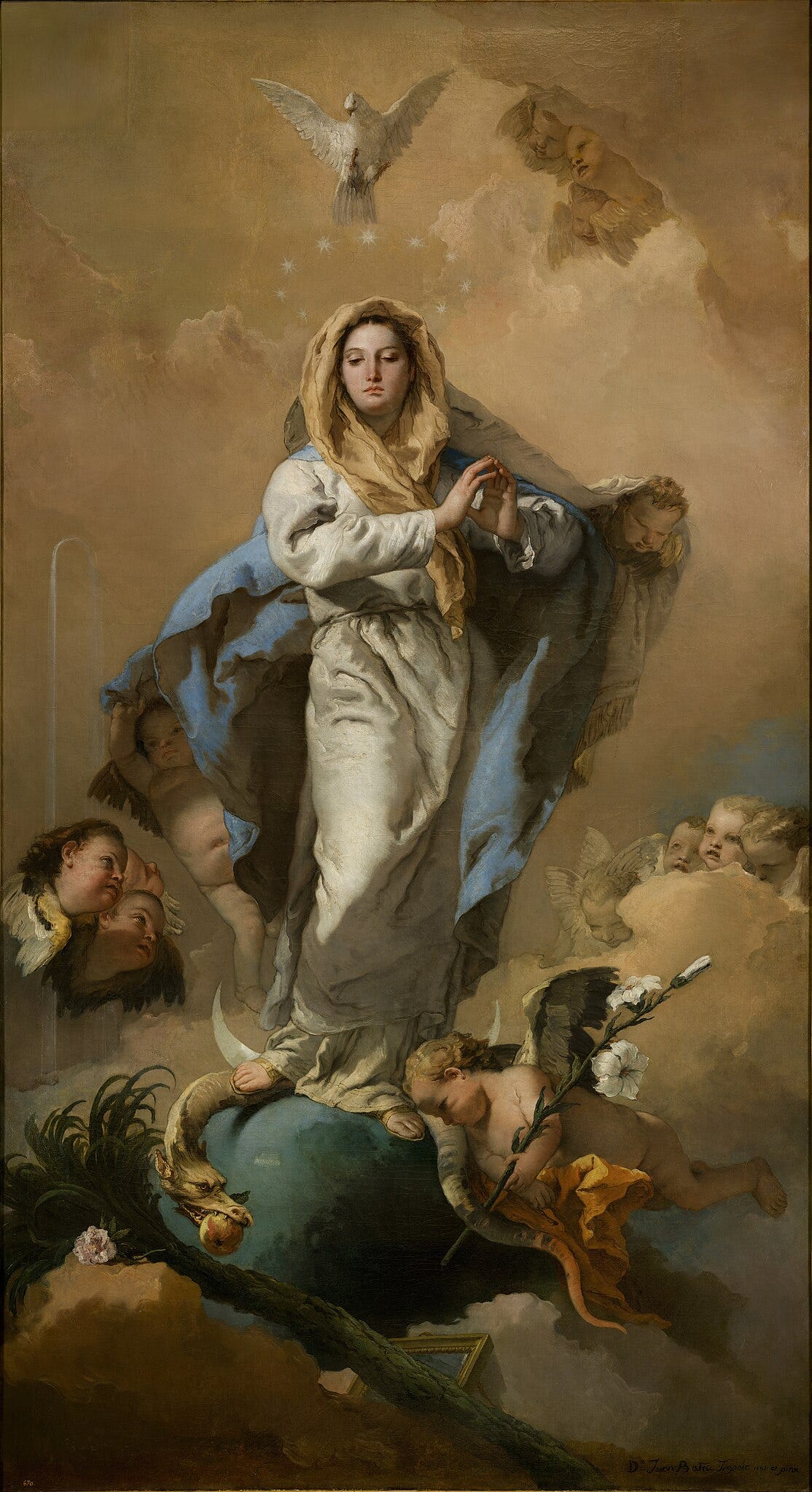
The Painting of the Most Pure Conception of Our Lady
Selection from El Arte de la Pintura (1649) by Francisco Pacheco, pp. 481–484.
Translated from this transcription with DeepL.com.
A few days after the previous story, the blessed day of the Immaculate Conception of the Blessed Virgin arrived. It should be noted that some people want her to be painted with the baby Jesus in her arms, as some ancient images depict her this way: perhaps based (as a scholar of the Society pointed out)1 on the fact that this Lady enjoyed original purity at that first moment, by virtue of her dignity as Mother of God, even though the time had not yet come for her to conceive the eternal Word in her most pure womb. And so from that moment (as the saints feel)2 she was the Mother of God, and at no time did she cease to be so, and such that it was not possible to be better, just as it was not possible to have a better son. But in order to avoid controversy over the painting of the child in her arms (for those who have a devotion to painting her this way), we will settle for the painting that does not have a child, because this is the most common, as shown by the medals that, at the request of the Holy Order of St. Francis (ancient defender of this Mystery), Leo X3 blessed, granting them many graces and indulgences: she has no child in her arms, but rather her hands, surrounded by the sun, crowned with stars, and the moon at her feet, with the cord of St. Francis around her. And this opinion is further reinforced by the fact that (in our Military Religion of this Mystery, instituted in Rome with the authority of His Holiness Urban VIII) Don Enrique de Guzmán, a knight from Seville, was sent on July 22, 1626, with the title of Ambassador to His Catholic Majesty. The stage with the habit, which is a very elegant Cross, and in the middle the image of Our Lady, with the baby Jesus in her arms. And then he stamped another second one without it, reforming the first one, which I can show you: something that makes a great impression on me, because it was sent at such a significant time. This painting (as scholars know) is taken from the Mysterious Woman that Saint John saw4 in heaven, with all those signs. And so the painting I mention is the one that most closely conforms to this sacred revelation of the Evangelist, and is approved by the Catholic Church with the authority of the saints and sacred interpreters: and there she is not only without the child in her arms, but even without having given birth to him, and we, having just conceived, give her a son. In accordance with this, the gifted Bernard,5 moistening his lips with sweet virginal milk, calls the Virgin a Miraculous Sign because she was so at the first moment of her Conception; for in her the Majesty of God displayed the infinite power of his ardent love and profound wisdom, not allowing original sin to enter. This miracle astonished the angelic spirits and confounded hell itself.
This Lady must therefore be painted in this most beautiful Mystery in the prime of her youth, aged twelve or thirteen, a most beautiful girl, with lovely, serious eyes, a perfect nose and mouth, and rosy cheeks, her beautiful hair spread out like gold, in short, as much as human brushes could possibly achieve. There are two kinds of beauty in man, namely of body and soul, and the Virgin possessed both incomparably: for her bodily appearance was a miracle (as St. Dionysius judged),6 and there was no creature more like her son, who was the model of all perfection. Other children are assimilated to their father and mother, as if from different principles, but Christ our Lord, having no father on earth, took after his Mother in everything, who after her son was the most beautiful creature that God created. And so the Holy Ghost praises her, whose words always apply to this painting: Tota pulchra es amica mea.7 She must be painted wearing a white tunic and blue cloak, as she appeared to Doña Beatriz de Silva, a Portuguese woman who later retired to Santo Domingo el Real in Toledo to found the Order of the Immaculate Conception, which was confirmed by Pope Julius II in 1511.8 Dressed in the Sun, an oval Sun of ochre and white, which surrounds the entire image, gently merging with the sky; crowned with stars. Twelve stars shared in a clear circle among rays of light, serving as a point on the sacred forehead, the stars on clear spots formed in pure white, which stand out above all the rays. It was painted better than any other by Don Luis Pascual,9 a monk, in the story of Saint Bruno for the great Carthusian monastery.10 An imperial crown adorns her head, which does not cover the stars. Beneath her feet is the Moon, which, although it is a solid globe (I took the liberty of doing so), is clear and transparent above her feet, while above, the crescent Moon is clearer and more vivid, with its points facing downwards. Unless I am mistaken, I believe he was the first to give these adornments greater Majesty, and the others have followed suit. In the Moon, I have especially followed the learned opinion of Father Luis del Alcázar, illustrious son of Seville, whose words are these:11 Painters usually place the moon at the feet of this Woman facing upwards, but it is evident among learned Mathematicians that if the Sun and Moon face each other, both points of the Moon must be seen facing downwards, so that the Woman was not on the concave side but on the convex side. This was necessary in order for the Moon to shine on the Woman who was above it, receiving the light of the Sun. And planted in a solid body, as has been said, although it had to be placed on the outer surface. God the Father, or the Holy Ghost, or both, are usually placed at the top of the painting, with the words of the Bridegroom, already mentioned. The attributes of the earth are appropriately arranged by landscape, and those of heaven, if desired, among clouds. It is adorned with Seraphim and whole Angels who have some of the attributes. The Dragon, the common enemy, had been forgotten by us, whose head was crushed by the Virgin, triumphing over original sin; it was always to be forgotten by us. The truth is that I never paint it willingly, and I will excuse it as much as I can, so as not to burden my painting with it: But in all that has been said, painters have license to improve upon it.12
Fr. Alonso de Flores.
S. Thom. q. 25, art. 6.
Before the death of the Pontiff in 1521.
Serm. in Apos.
G.amis.lib.3 de N.Señora.6.2.1.
Fr. Vincent. Justin. in defense of S. Luis Bertran.
Luis Gaudín.
The Carthusian monastery in Seville is a large Carthusian monastery, given that Pacheco describes the works, it is that he saw them, although the great Carthusian monastery in Grenoble is suggested, due to the abbreviation, but in any case, neither of them know about Gaudín, although it is said that in 1742, Saint Bruno and the Immaculate Conception… the works were transferred to the Carthusian monastery of Cazalla de la Sierra in Seville. In 1836, this monastery was abandoned during Mendizabal’s confiscation, so we can assume that they were lost or never found.
Regarding c. 12 of the Apoc. ver. 1.
The Immaculate Conception, now in the church of La Magdalena, is surely his or from his workshop; some even attribute it to Velázquez as an apprentice.