
Wild Things
Innocence, once lost, can never be regained.

In my twenties it was not uncommon for me to ride-share with my peers. However chatty or not the traveling party would be, one particular aspect of those car rides was that the radio was usually off. I had a feeling there was an unspoken rule that each person had their own taste in music they wished to keep to themselves. There was one friend, though, with musical preferences diametrically opposed to mine who would be the exception to this rule. On one occasion I was brave enough to share “Like Moths to Flame” by the post-hardcore band Thrice along with a commentary on its recounting of Saint Peter’s betrayal of Christ. Soon afterwards my friend returned the favor by playing “Wild Things” by the Christian hip-hop artist Andy Mineo.
[Hook]
I wanna go where the wild things are
I wanna go where the wild things are
I wanna go where the wild things are
I’m talking lions, tigers, bears (oh my)
Lions, tigers, bears (oh my)
Lions, tigers, bears (oh my)
Christ died for this terrible heart
That’s why I wanna be where the wild things areWelcome to the church in the wild
I live with dudes haven’t been to church in a while
I’ve chosen this lifestyle, you ever met my friends?
Porn stars, dope dealers, they like, “Why you chill with them?
I thought you was a Christian?” Yeah I’m on that team
But I’m with them cause my life’s the only bible that they’ve ever seen
Some wanna be an earshot from the church bell
I wanna win souls, make gunshots in the worst hell
Telling ‘em Christ became a curse for they sin with my words and my works
They won’t come in? I’m bringing church to them
Yeah, that’s why I live where I live
They say, “You acting cray, that ain’t no place to raise your kids”
But um, but um, but um, but um, but um
If we ain’t living it who else gon’ show em
What a family supposed to look like instead of them broken homes
Gotta be living stones around where they getting stoned
Live and know Him, die to make Him known ‘til He take us home, let’s go[Hook]
If you catch me in a bar where the wild things are
With my pastor and an entourage who loves God
Please don’t think that it’s odd, we kick it ‘round broken hearts
Fishing for men, surrounded by sin but ain’t taking part
I talk about Jesus, all the Christians love me
I walk like Jesus now they wanna judge me, ain’t it funny?
I’m duckin’ stones thrown from the Pharisees
Gospel of peace up on my feet like a pair of cleats
Walkin’ with the Paraclete, that’s Greek for the Spirit
They say the wild things’ll eat you up
Who shall I fear when God is walking with me
If I die that’s a win, that’s the seed of the church plus I get to be with Him
And we so undefeated like Hanes made our sneakers
I had beef with Jesus and my sin it got deleted
So I gotta go and speak it to those who really need it
Let the Gospel off the leash, go and be where the beasts at[Hook]
Sizing Up
Those three-and-a-half uncomfortable minutes have stayed with me for over a decade. Given that Mineo presents himself not as an musician who’s Christian but as a Christian musician, I take for granted that he’s singing this song in earnest. And so this is not “just a song, man.” I take seriously his prescription that the badge of true Christian living is to raise your family in a den of sin and tempt God with martyrdom in the process. It’s bad enough that his song extols pride in the form of a reverse “keeping up with the Joneses,” but the gap between this song’s release (April 2013) and the birth of Mineo’s first child (April 2025) betrays a hypocrisy and recklessness unbecoming of a Christian influencer.

My intent here is not to review a random rapper’s track but instead to detail the duty that guardians of the innocent have to vehemently guard the innocence of their charges. In my previous article I argued how the construction of a child’s worldview is heavily influenced by the environment he lives in, which is shaped most by his parents. Moving from the “syntopical” to the “synoptical,” Our Lord in three Gospel accounts reserves one of the severest warnings of His ministry to those who influence the young:
But he that shall scandalize one of these little ones that believe in me, it were better for him that a millstone should be hanged about his neck, and that he should be drowned in the depth of the sea.—Matthew xviii. 6.
And whosoever shall scandalize one of these little ones that believe in me; it were better for him that a millstone were hanged about his neck, and he were cast into the sea.—Mark ix. 41.
It were better for him, that a millstone were hanged about his neck, and he cast into the sea, than that he should scandalize one of these little ones.—Luke xvii. 2.
It goes without saying that intending to have your children mix with tweakers and crackheads is scandalous, so we can finally put “Wild Things” to bed. But avoiding scandal doesn’t only mean not taking your child to a naturist beach or to an “art” exhibit featuring crucifixes submerged in urine. Bishop Richard Challoner’s commentary on the Douay-Rheims has this note on the phrase “shall scandalize”:
That is, shall put a stumblingblock in their way, and cause them to fall into sin.
The broadness of what can constitute scandal should strike holy fear in any parent. Of course, one should lead by example through a life of prayer, grace, virtue and subdued passions so as not be a source themselves of scandal to their children. But this is not enough. The Prince of the Apostles preached vigilance against the devil whose jaws are ready to close on any and all members of your family:
Fratres: Sóbrii estóte, et vigiláte: quia adversárius vester diábolus tamquam leo rúgiens círcuit, quærens quem dévoret: cui resístite fortes in fide.
Brothers: Be sober and watch: because your adversary the devil, as a roaring lion, goeth about seeking whom he may devour. Whom resist ye, strong in faith.—I Peter v. 8–9.
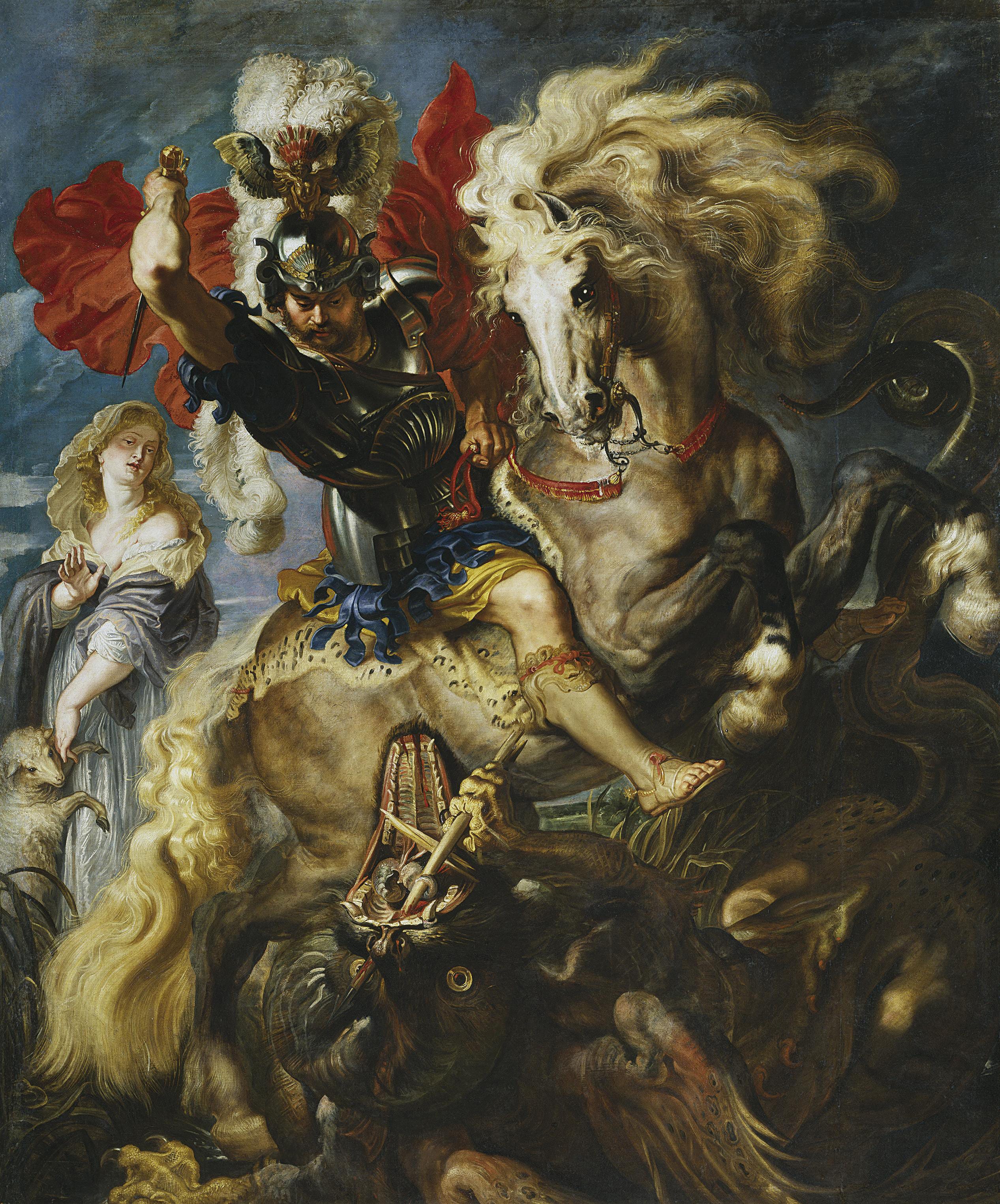
Every single Compline begins with these words. Every single one. Again, faith is essential in this resistance but it must be complimented with sobriety and watchfulness. This holy trident is the premier weapon against the spiritual dark triad of the world, the flesh and the devil. As the focus extends to the protection of one’s children, this means that not only must a strong spiritual rigor exist in the family but that parents must combat against inclinations towards naïveté and permissibility with regards to external influences.
Sleight of Hand
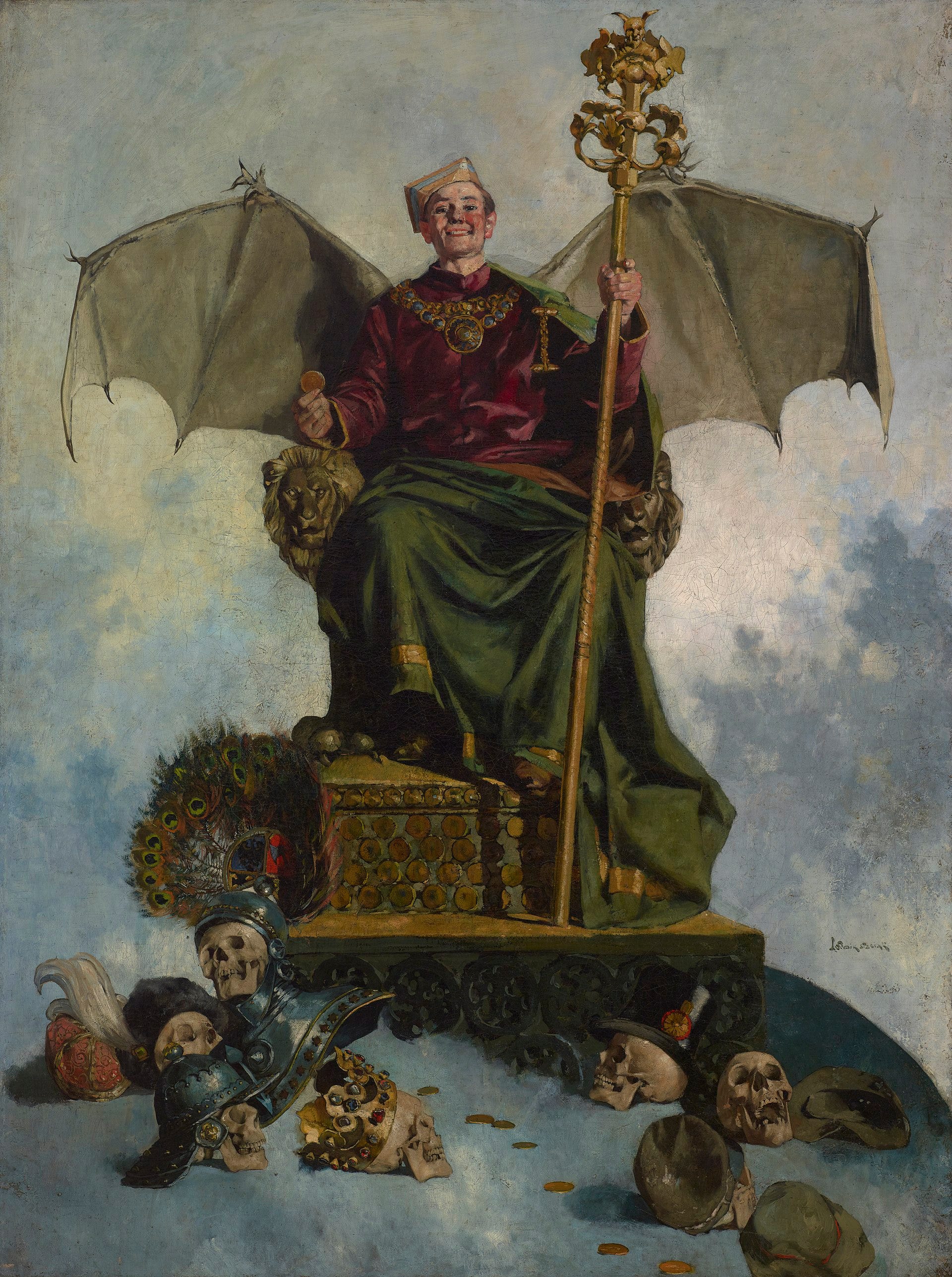
_-_Alegory_of_Satan_(Lord_of_the_World)_-_MNK_II-b-3252_-_National_Museum_Krak%C3%B3w.jpg)
There is admittedly an exciting dimension in stories where the devil is portrayed as dramatic antagonist, as he is in the Temptation of Christ or in accounts of demonic possession. But he doesn’t have to promise you the world’s riches or turn your head 180° to get your attention. The coin he presents as payment of service could be as cheap as the license to care what others think, to care about fitting in, to indulge in that one hedonistic attachment for nostalgia’s sake, to keep up with the latest cultural references, to not rock the boat. And as Stasiak portrays in his Satan, there’s an unabashed smugness in his seemingly friendly offer. “Sure, take that load off. You deserve it. Why try so hard? No one else is. Everyone knows raising kids is hard. You need an outlet so go watch that show. They can’t be bored so go give them a screen. It’s only the kids channels so you don’t have to worry. Sleepovers are a great way for them to socialize. You’re all going to Mass so you’re strong enough to handle it.” And with each successive nod of approval we give to these platitudes we drift further and further into the apathy that plagued the Patient in The Screwtape Letters.
The reason why I go to great pains to shield my children from influences as seemingly innocuous as Disney Jr. is because I’ve personally been badly burnt by immoral media. When I was six I received a Super Nintendo bundled with the violent fighting game Killer Instinct which gave me nightmares for years. At eleven I found the Skinemaxes on the high-numbered channels of the satellite box. At twelve I stumbled upon lewd literature in a closet corner. At thirteen I surfed the unrestricted web at broadband speed, impure sites and all. I bring this all up not to air out dirty laundry from my upbringing or to bring an apple anecdote into an orange subject. I know the massive grace and time it takes to become unshackled from habitual vice. I know, too, how slyly the Enemy is employing the media and the mediums to enslave the likes of my little ones. On one end, Sesame Street recently “came out” in support of the world’s perverted dedication for the month of June. On the other end, if you misspell “Thomas the Tank Engine” on YouTube you risk seeing a thumbnail for “Thomas the Shank Engine.” Though misattributed to John Milton, the following adage summarizes not only his Paradise Lost but also my rant to this point:
Innocence, once lost, can never be regained.
Darkness, once gazed upon, can never be lost.
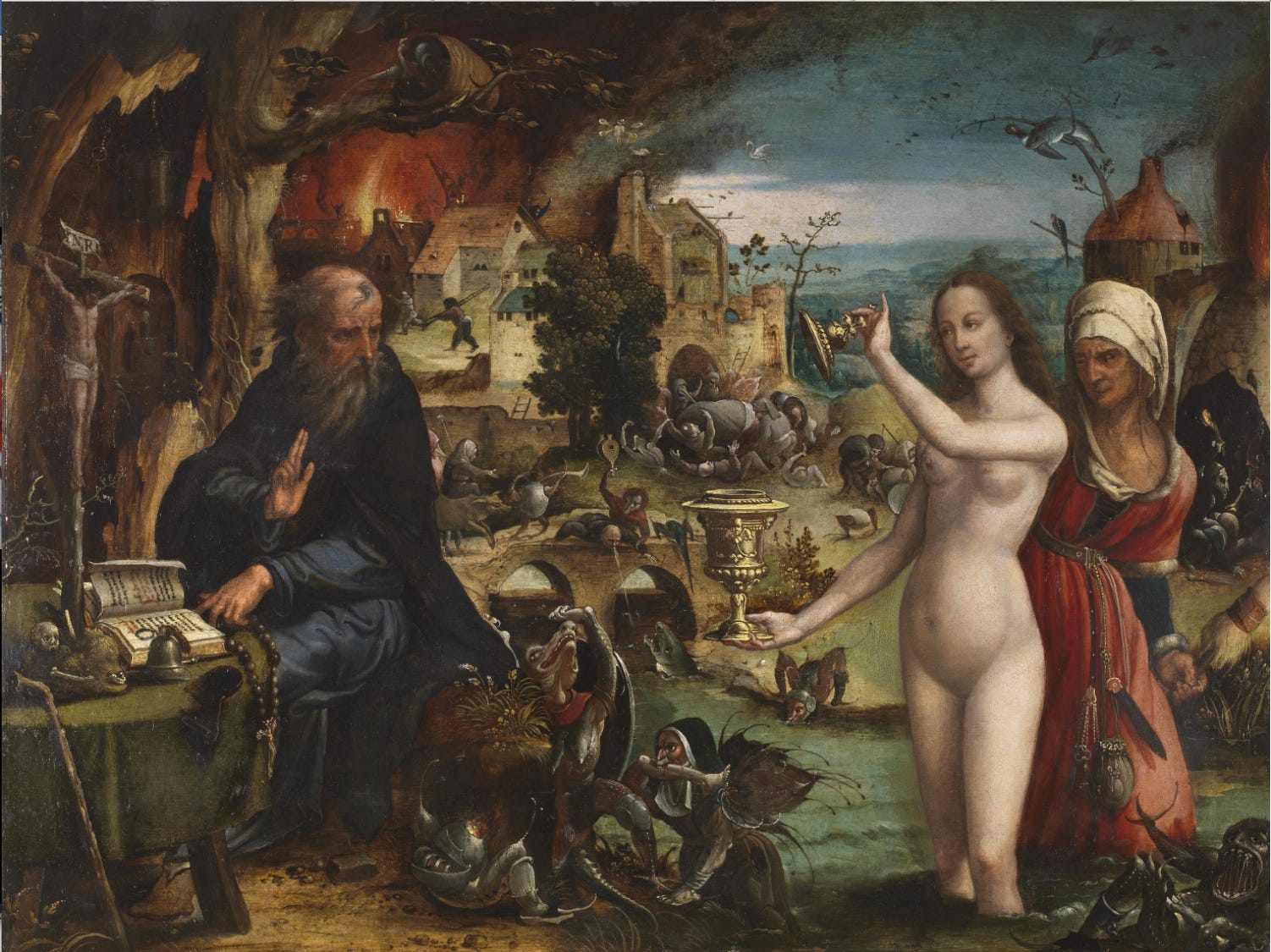

My eldest does definitely act the brat at times, and it is this which led to the television set being boxed up in the shed more so than John Senior’s advice to smash it. And as his First Communion preparation taught, this brattiness also manifests in actual sin. But all of this is not to say that he doesn’t possess innocence. When I listened to an audiobook of Pinocchio last year I knew it needed to be part of our next family drive. My son at five not only followed the plot well but enjoyed the story immensely. I was surprised, though, at one episode which he didn’t grasp. After his time in the theater, Pinocchio is befriended by the Fox and the Cat who are out for his gold and hatch a plan to scare it out of him as cloaked assassins, eventually resorting to hanging the marionette. This also failing, they return the next day with their old clothes and smiling faces executing one more swindle which proved successful. What was lost on my son, even when reading a book with illustrations, was that the Fox and the Cat were also the assassins. He couldn’t see that people who behave so kindly could be so cruel. Up through this past Holy Week he thought that Judas being a traitor meant he traded something for Jesus (which was accidentally true). It took several reads of God Died at Three O’Clock for him to comprehend the reality of a friend becoming an enemy, reducing him to tears. This is what needs to be preserved. This is what cannot be corrupted.
Sanctity as Shield & Sword
It should come to no surprise that Saint Nicholas is regarded as a patron of children. In Rev. Alban Butler’s abridged Lives of the Saints we read of his famous patronage on behalf of three sisters:
Throughout his life he retained the bright and guileless manners of his early years, and showed himself the special protector of the innocent and the wronged. Nicholas once heard that a person who had fallen into poverty intended to abandon his three daughters to a life of sin. Determined, if possible, to save their innocence, the Saint went out by night, and, taking with him a bag of gold, flung it into the window of the sleeping father and hurried off. He, on awaking, deemed the gift a godsend, and with it dowered his eldest child. The Saint, overjoyed at his success, made like venture for the second daughter; but the third time as he stole away, the father, who was watching, overtook him and kissed his feet, saying: “Nicholas, why dost thou conceal thyself from me? Thou art my helper, and he who has delivered my soul and my daughters’ from hell.” […]
Reflection: Those who would enter heaven must be as little children, whose greatest glory is their innocence. Now, two things are ours to do: first, to preserve it in ourselves, or regain it by penance; secondly, to love and shield it in others.
This responsibility of protecting our own innocence and especially those of children is given a different emphasis in Butler’s The Lives Of The Fathers, Martyrs, And Other Principal Saints. Here we read that teachers of children must not only possess right content but more importantly right conduct if their instruction have any hope of being received:
To impress on the minds of children perfect sentiments of devotion, religion, and all virtues, with an earnestness in all duties, is a task often as delicate as it is important. Instructions must be made sensible, and adapted by similes, parables, and examples, to the weakness of their capacities. Above all, they are to be enforced by the conduct of those with whom children converse. They learn their maxims, imbibe their spirit, and are moulded upon their example. […] Precepts and exhortations lose their force when contradicted by example; and while the infant sees every one study to please himself in every thing, in flat opposition to the rules of the gospel which he hears preached from their mouths, he seems tacitly persuaded that such a conduct is reconcileable with those very maxims which condemn it.
Woe to me if I offer my children Treasure Box books with Saint Thérèse of Lisieux stories alongside a tablet with access to episodes of Vampirina. What a shameful relinquishing of spiritual authority that would be!
Thus far having presented my own views leading to a stance of guarded child rearing, it is worth mentioning that my wife is also convinced of this “eyes wide open” parenting approach. However, this is not the case with extended family members who oftentimes view our restrictions as oppressive and pathological. So when the accusations of pride and the attempts to gaslight ensue, my guardian angel reins in my choleric inclination to outburst and reminds me of Saint Teresa of Avila’s warning against bad company:
I had certain cousins-german who frequently came to my father’s house; and these only were admitted, for my father was very prudent and circumspect, and would to God he had been so in regard to those likewise, for I now see the danger there is, in an age when virtues are to be planted in the soul, to converse with persons who, not knowing the vanity of the world, are the more inclined to excite others to throw themselves into it. […] If I could advise parents, I would entreat them to take great care what kind of persons their children converse with at that age [six to fourteen years old], for great mischief may thence arise, since our nature is more inclined to evil than to good. Thus it happened to me.
Yes, we’ve had family members who’ve been stumblingblocks, who’ve been scandals to our sons. Yes, we’ve had individuals who should’ve known better than to skirt the boundaries, ignore the rules and undermine the authority we have as parents to our children. When the occasion calls for it, I have to hate those relations as Our Lord required:
If any man come to me, and hate not his father, and mother, and wife, and children, and brethren, and sisters, yea and his own life also, he cannot be my disciple.—Luke xiv. 26.
To the sorely offended detractors who are ready to burn my effigy, Bishop Challoner tempers the phrase “hate not” by clarifying:
The law of Christ does not allow us to hate even our enemies, much less our parents: but the meaning of the text is, that we must be in that disposition of soul, as to be willing to renounce, and part with every thing, how near or dear soever it may be to us, that would keep us from following Christ.


Saint Peter, who has been mentioned several times already, can account for the dangers in sharing company with those who are not ardently attached to his Master. Rev. Roger Baxter, S.J. in his Meditations For Every Day In The Year offers this reflection:
Peter remained in the same company, in which he had first denied his Master, and being accused by others of being Christ’s disciple, he persisted in his denial a second and a third time. “He began to curse and to swear that he knew not the man” (Matt. xxvi. 74), unmindful of the first crowing of the cock. Observe the different effects of good and evil company. When Peter was with his Master and fellow Apostles, he was so fervent as to offer to die with Christ, but in the evil company in which he afterwards was, he protests and swears, that he never knew the man. Learn from this melancholy example to avoid evil company and conversation; and always bear in mind the oracle of St. Paul: “Evil communications corrupt good manners.” (1 Cor. xv. 33.)
Though I believe I’ve built a solid defense, I wouldn’t say I’m above correction in my opinions. The correction just has to come from the right place. After Mass recently I was standing next to the priest witnessing a very enthusiastic parting between two family members. He says to me with some subtle sarcasm, “Grandparents are supposed to spoil their grandchildren.” With matched tone I reply, “That’s what some say, though I know what I’m supposed to do as a parent.” He chuckles and says, “No one really is supposed to spoil a child.” Seeking some oblique affirmation for my parenting philosophy, I declared, “If one of my children ends up spoiled, then it’s both my problem and my fault.” Wisely perceiving my intent, he calmly reassured, “Well, you’d hold some responsibility for that but not all of it. Others would have their own share of the fault to carry.”
So I’ll continue to extol the light of the faith and deride the pomps of the devil; I’ll continue to burn the twaddle books and replace them with classic literature; I’ll continue to hold extended family at arm’s length and remind them of no-go zones. All the while I’ll remember that my sons have me as a father and God as a Father. In the end, I can only protect my children against so much and ultimately, years down the line, the fault will be all their own. But as long as they are little I’ll defend their littleness with the ferocity of a soldier under Christ’s standard.
This is a great post Kelvin. Best line hands down -"It goes without saying that intending to have your children mix with tweakers and crackheads is scandalous, so we can finally put “Wild Things” to bed."