Mater Salvatoris
She shall crush thy head, and thou shalt lie in wait for her heel.

In this second installment of investigating the Immaculate Conception portrayed in Baroque art, the focus will shift to some tangential subjects which will see integration in the subsequent concluding article. It would be helpful for readers to revisit the first post in this series.
Speculum Sine Macula

The Baroque era of art (i.e., the decades roughly between the 1590s and the 1750s) has an unmistakable Catholic character. Coincident with the post-Tridentine Counter-Reformation, the paintings, sculptures and architecture all give roaring witness to the splendid mysteries of the One True Faith which the heretic iconoclasts sought to obfuscate and shiel…
Madonna and Child
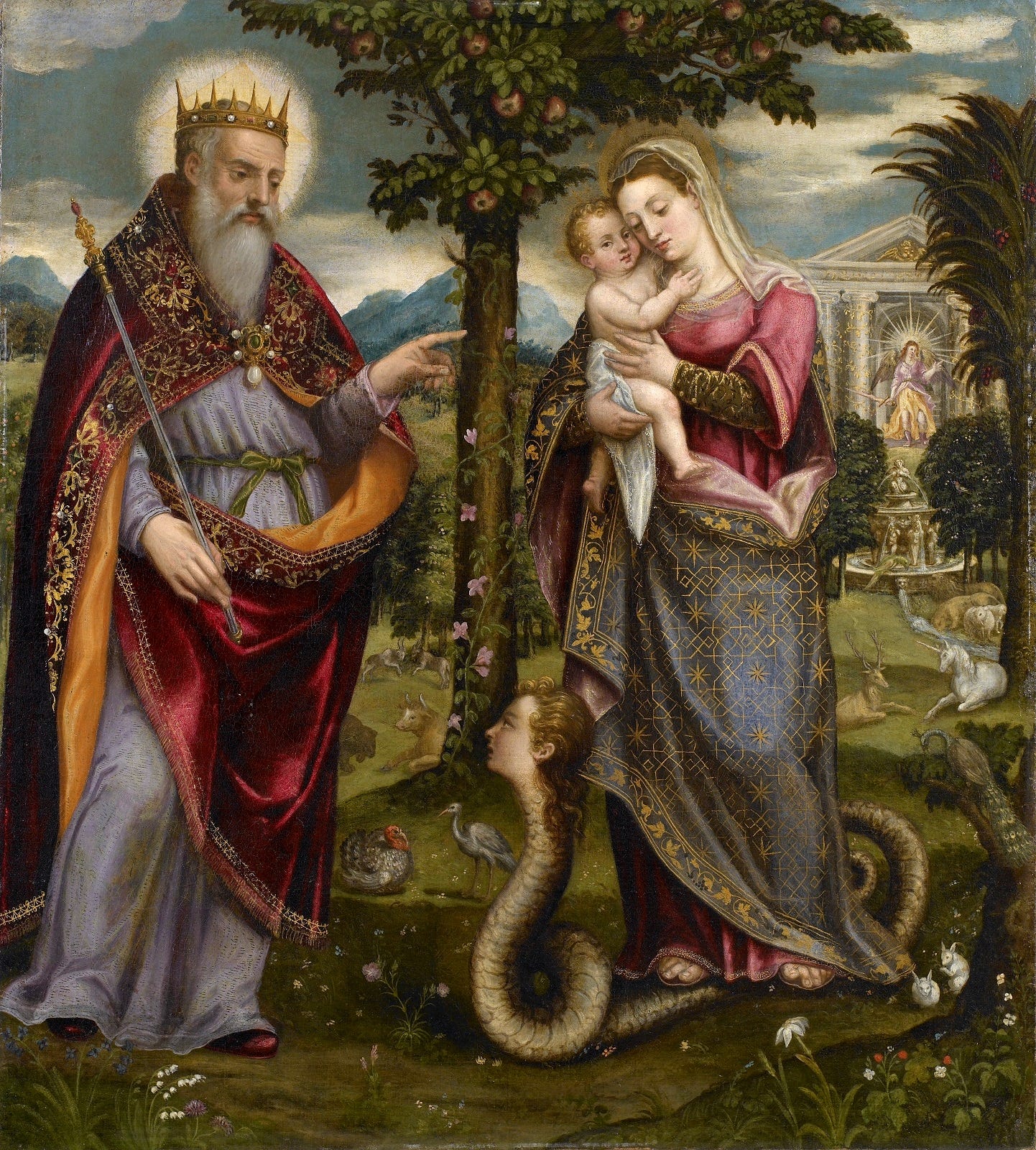
Though the earliest renditions of Our Lady in art depict her as a solitary intercessor, by far the most popular subject representing her is that which has her holding the Divine Infant, also known as Madonna and Child. There are thousands of such depictions throughout the centuries, with plentiful variations of setting and supporting cast. Sometimes the pair are in a quiet room, sometimes outside and sometimes on a throne. Sometimes they are joined by Saint John the Baptist, Saint Joseph, the parents of the Virgin or poor anonymous children begging for alms. There is one particular character which I’d like to highlight that makes a rare appearance for highly symbolic purposes.
Inimicitias ponam inter te et mulierem, et semen tuum et semen illius: ipsa conteret caput tuum, et tu insidiaberis calcaneo ejus.
I will put enmities between thee and the woman, and thy seed and her seed: she shall crush thy head, and thou shalt lie in wait for her heel.
—Genesis iii. 15.
It has been detailed previously regarding paintings of the Immaculate Conception, specifically in Pacheco’s instructions, that the ancient serpent should make an appearance under Our Lady’s heel if the artist feels up to the task.
The Dragon, the common enemy, had been forgotten by us, whose head was crushed by the Virgin, triumphing over original sin; it was always to be forgotten by us. The truth is that I never paint it willingly, and I will excuse it as much as I can, so as not to burden my painting with it: But in all that has been said, painters have license to improve upon it.
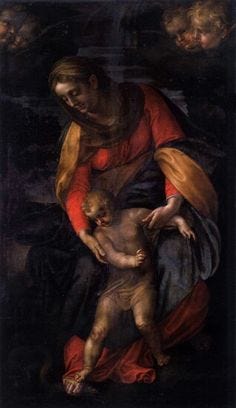
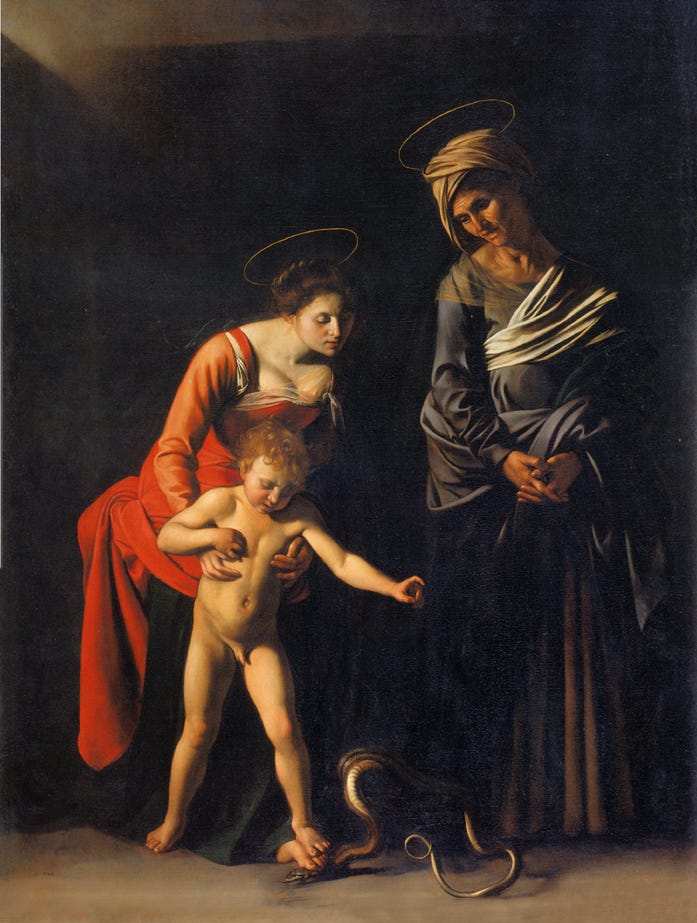
The Baroque Madonna and Child paintings below showcase a plethora of approaches to the handling of the serpent. The enemy is depicted anywhere between a simple snake to a Lilithian chimera (EDIT: More examples of the latter can be found on Wikimedia). Either Mary or Jesus or both together step on the serpent, giving credence to the varied valid opinions on who does the crushing while still maintaining Our Lady’s co-redemptive involvement.


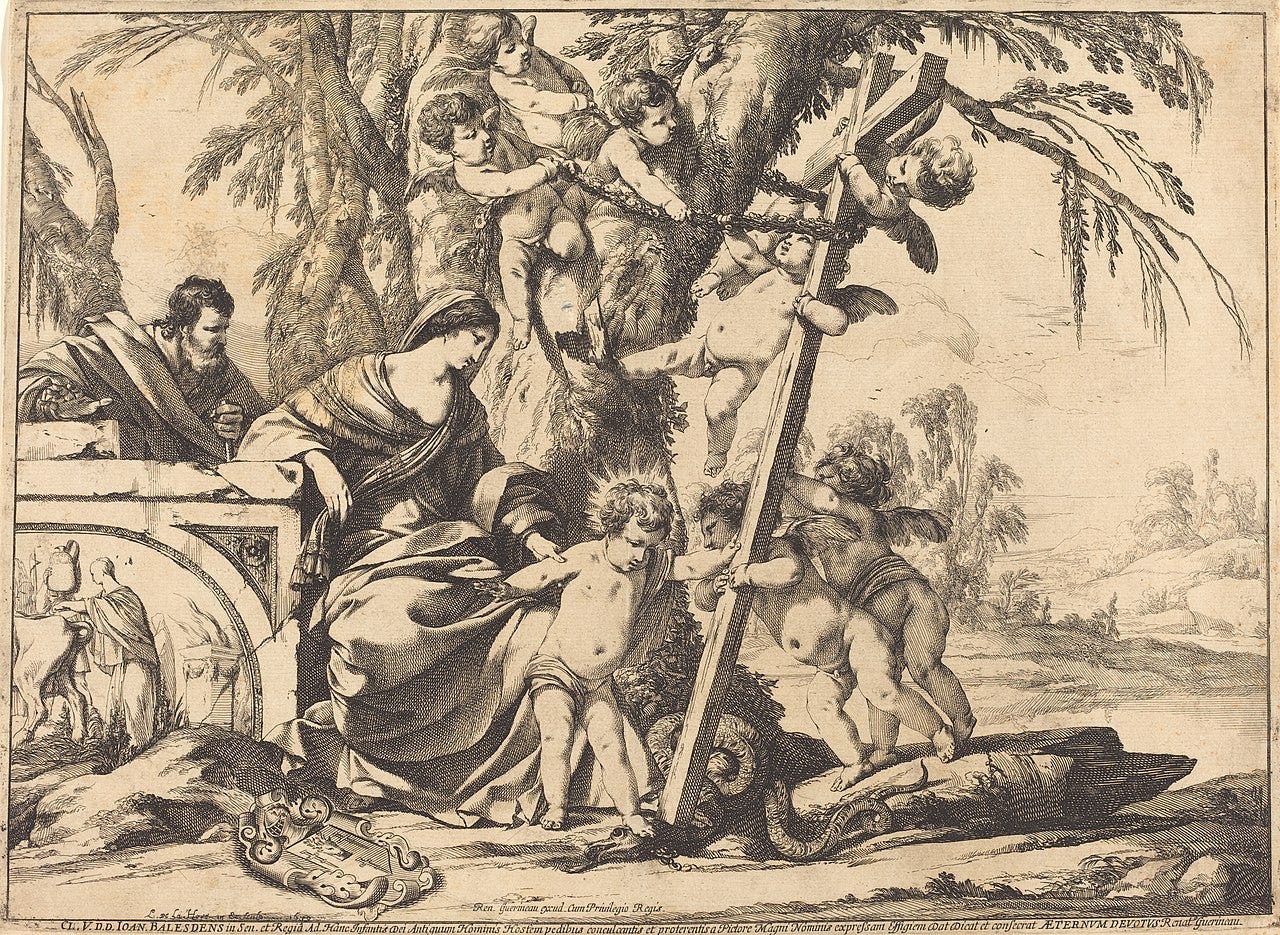

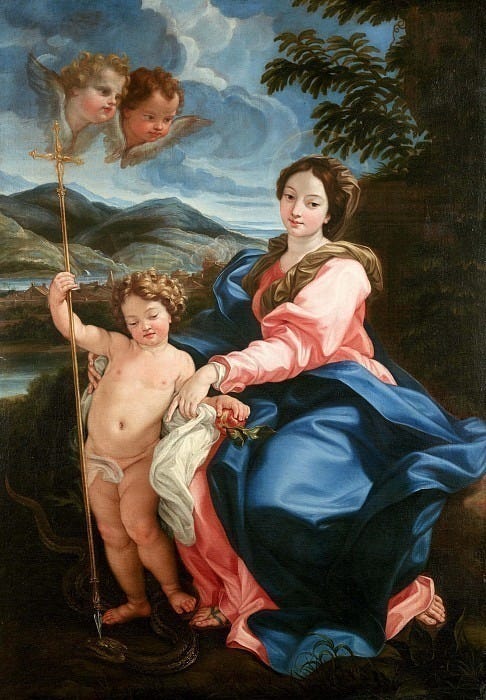
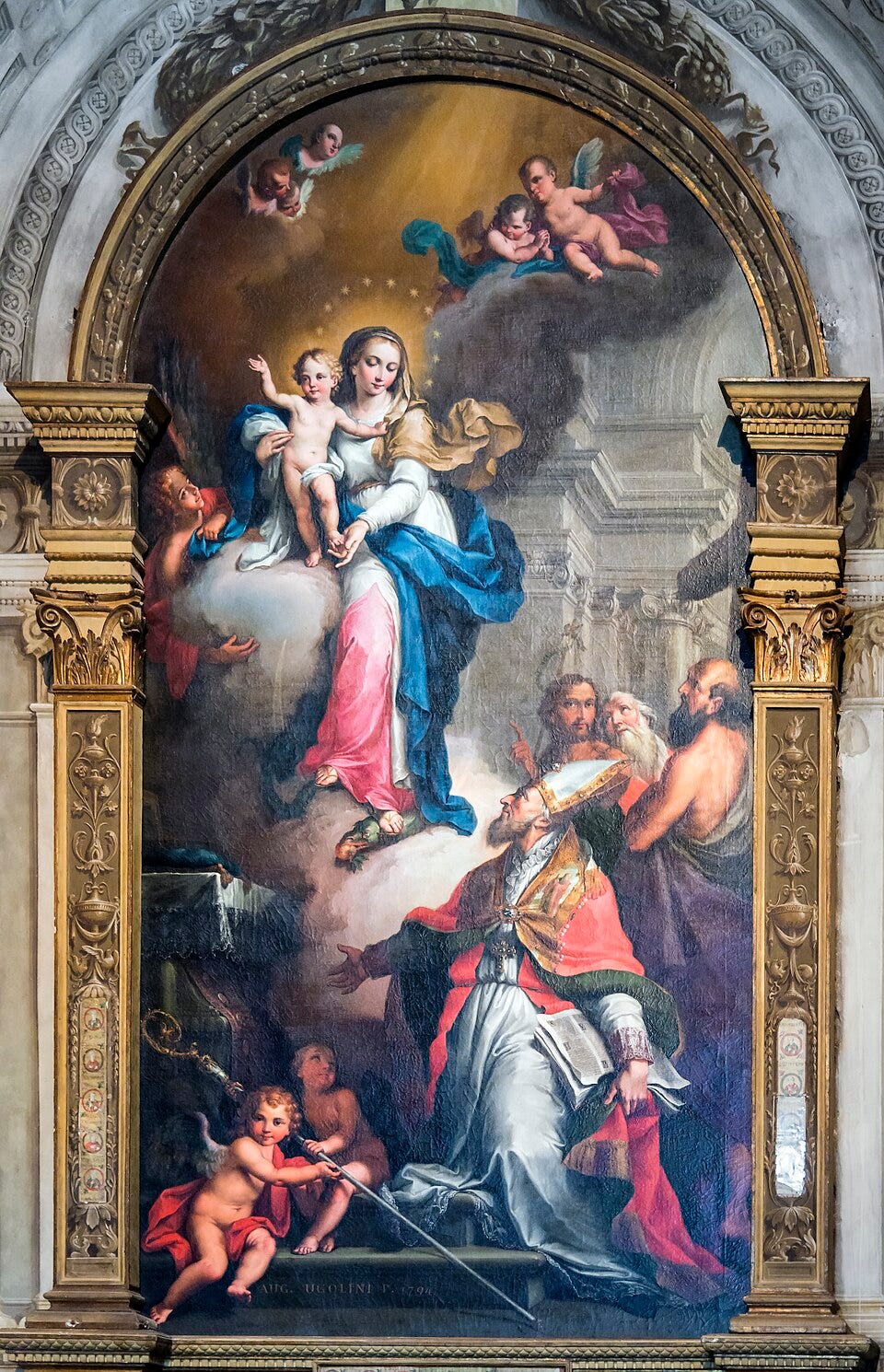
_-_Interior_-_Nave_left_part_-_Capella_Maffei_-_Agostino_Ugolini.jpg)
Passion, Death and Resurrection of Our Lord
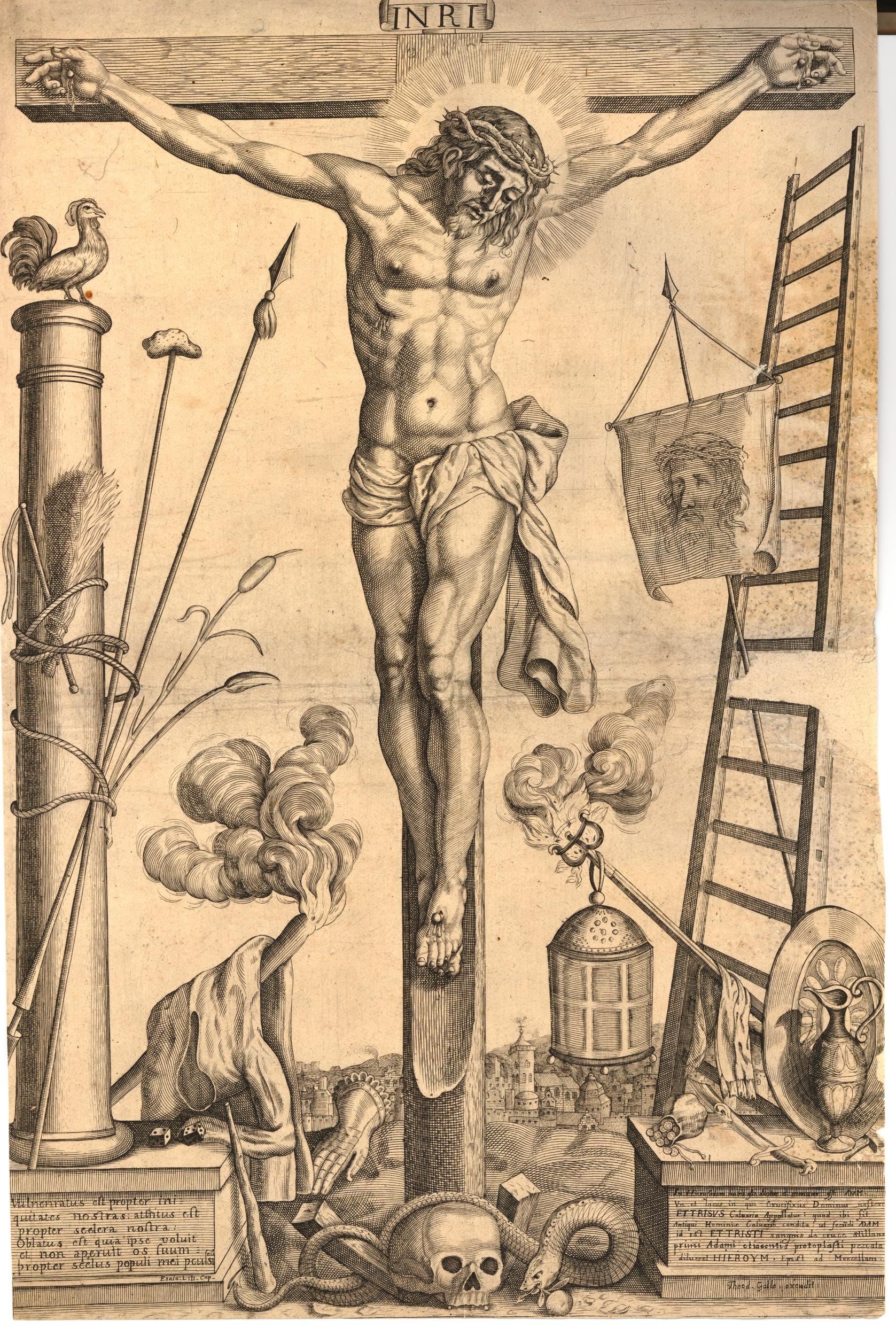
Though not as closely tied with depictions of the Immaculate Conception, it would be advantageous here to bring awareness of Our Lord as an adult crushing the serpent in His Saving Act on the Cross. The most common subject where this can be seen is that of the Crucifixion where serpent wrapped around a skull, symbolizing death through Adam’s sin, at the base of the Cross.
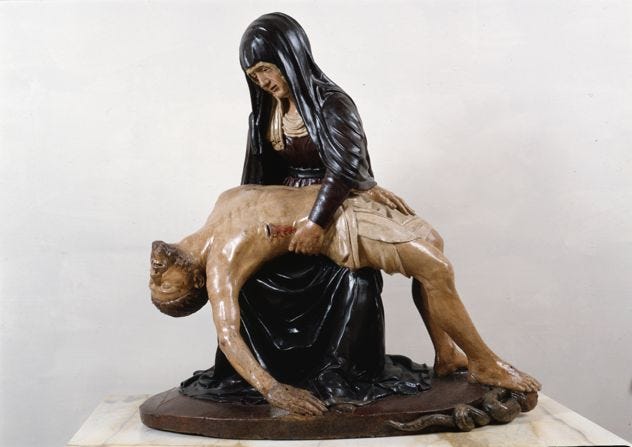
The German version of the Pietà, called Vesperbild, is typically much more graphic than its Italian counterpart and in at least one case, that of the walnut sculpture by Lorenzo di Pietro (il Vecchietta), shows a woman-headed snake under Christ’s foot.
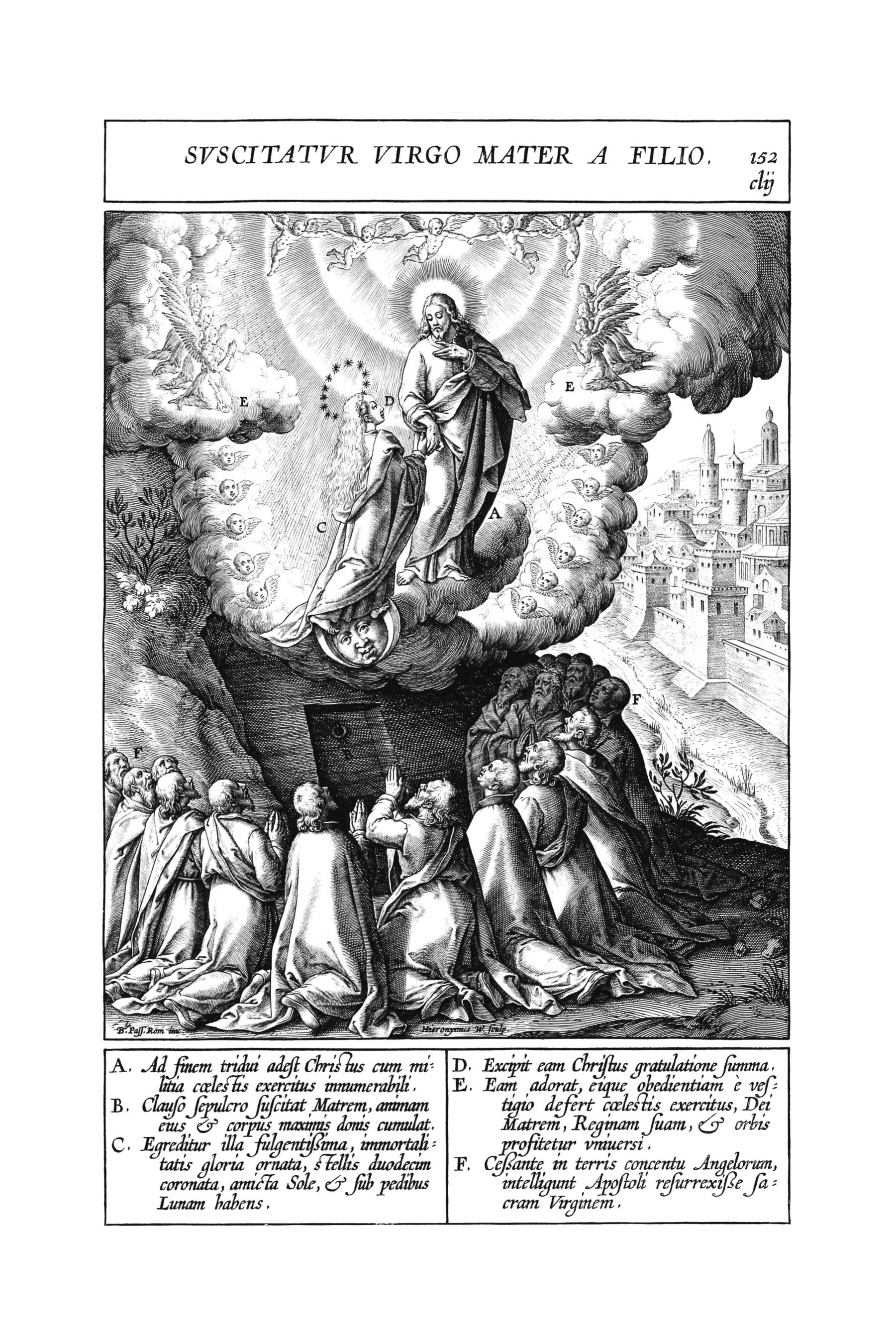
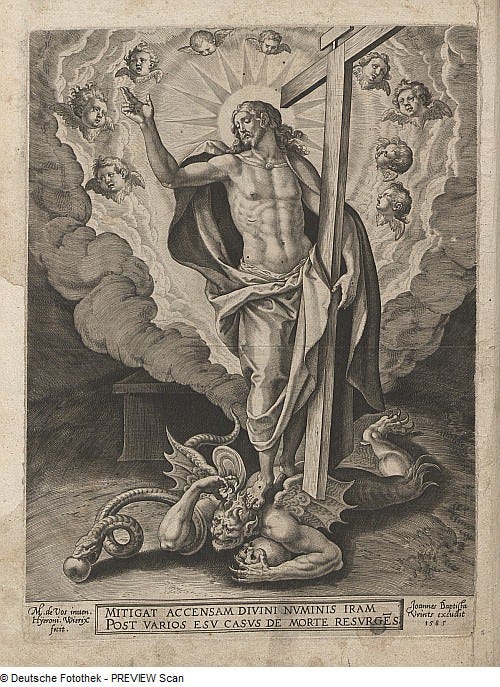
Rarer still are images of Christ crushing the serpent after His Resurrection. The sole example I found was by the Flemish engraver Hieronymus Wierix, executed during his stint as a Lutheran, having a strange title which translates to “It soothes the fire of the divine wrath; after various trials, you rise from death.”
Postscript: Mary, Queen of the Universe
A few weeks ago, my family assisted at a Confirmation ceremony in Sanford, FL. I saw it as an apt opportunity to visit the Basilica of the National Shrine of Mary, Queen of the Universe which was roughly a half-hour drive from where we were staying. At the rear right of the church, immediately before exiting into the nave, I found what I was looking for: a 9-foot full-size copy of Murillo’s La Inmaculada Concepción de los Venerables.
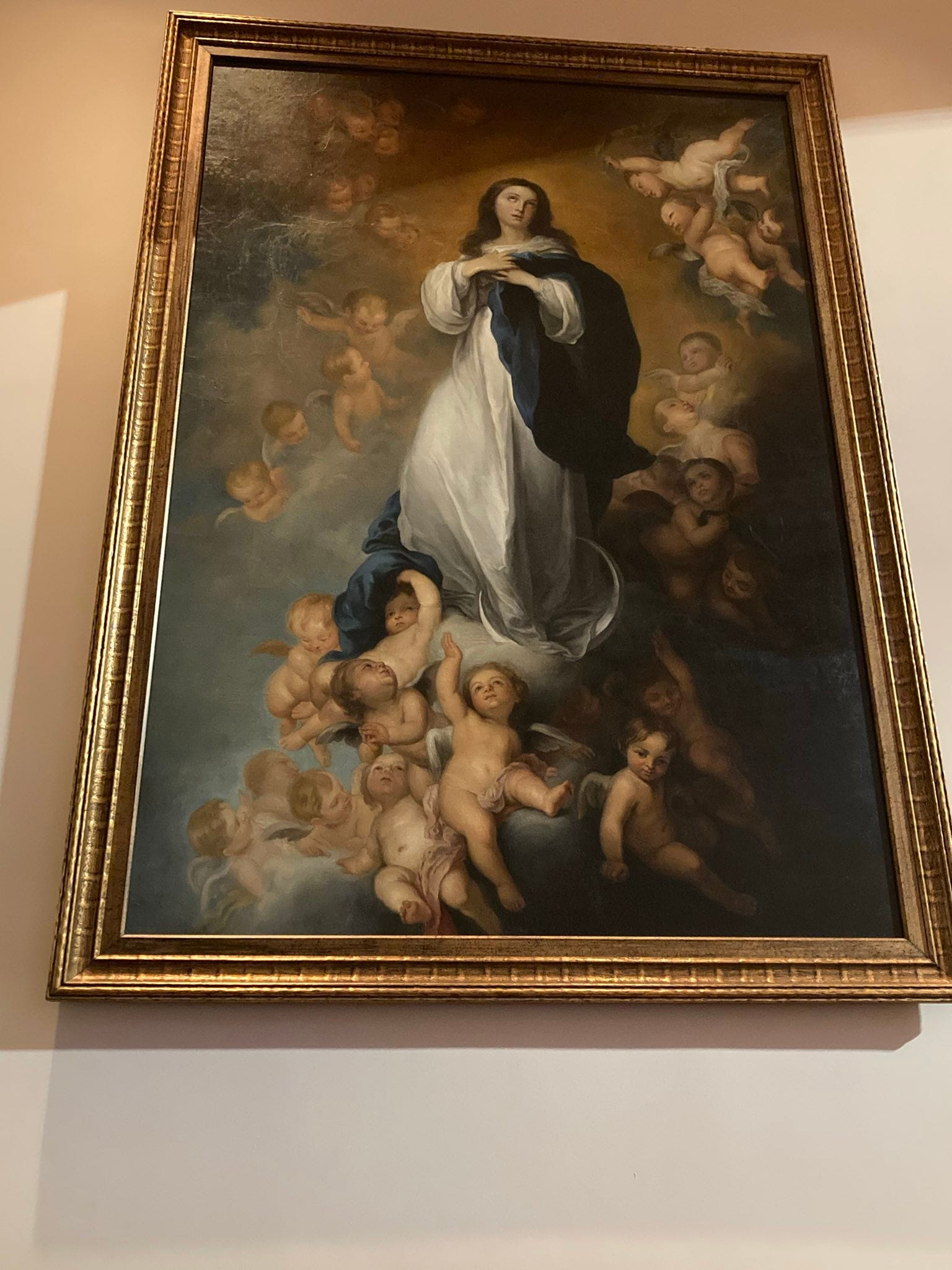
Though the Shrine’s Museum has been closed since 2020, I was happy for my family’s sake that they kept this available for public view. My joy was heavily tempered, however, when I read the placards underneath the painting.
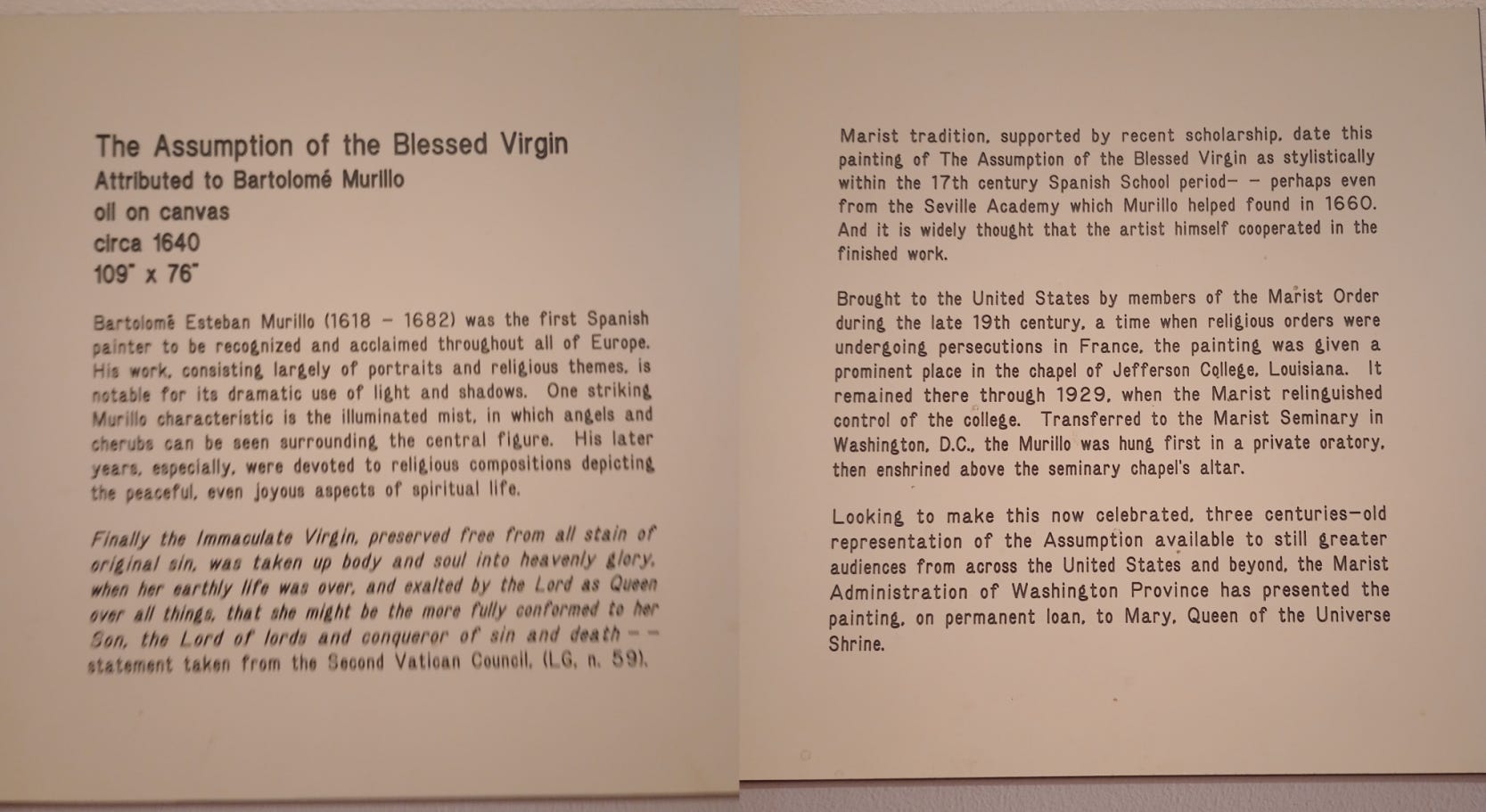
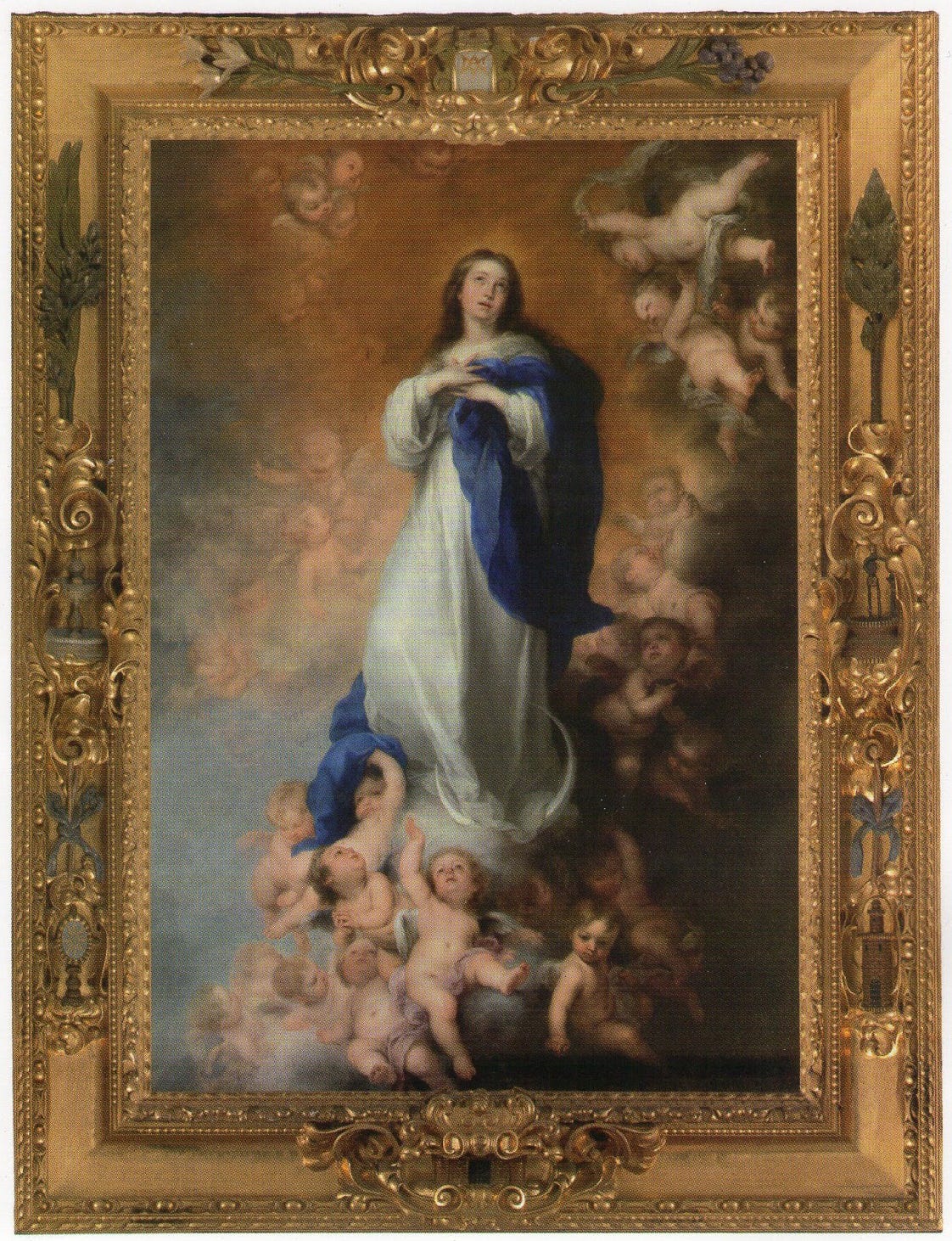
It boggled my mind that a copy of THE MOST FAMOUS of Murillo’s 20-odd Immaculate Conceptions, the original of which has been housed for the last 170+ years in either the Louvre in Paris (1852–1941) or the Museo del Prado in Madrid (1941–present), could have been mistaken as a picture of the Assumption. I mean, we’re not talking about Murillo’s Walpole Immaculate Conception where the mistake could honestly be made. From the Museo’s own article on the painting:
In the present work, the absence of the Virgin’s traditional attributes -the tower of David, the sealed fountain or the palm and cypress trees- may have to do with their presence in the frame described by Torre Farfán, which is still at the Hospital. They may have been included in the frame to provide the symbolism lacking in the painting (Text drawn from Cenalmor, E. in: Murillo y Justino de Neve. El arte de la amistad, Museo Nacional del Prado, 2012, pp. 114-117).
In the aforementioned 2012 exhibition Murillo y Justino de Neve: El arte de la amistad the painting was reunited with its frame, replete with Tota Pulchra imagery, for the first time since its looting in 1813 nearly two centuries prior. Gabriele Finaldi discussed some of these points in both his Introductory and Conference lectures.
(EDIT: Added new links above and video below.)
And yet this misattribution, “supported by recent scholarship,” has been continually perpetrated by the Shrine since they acquired the painting in 1998.
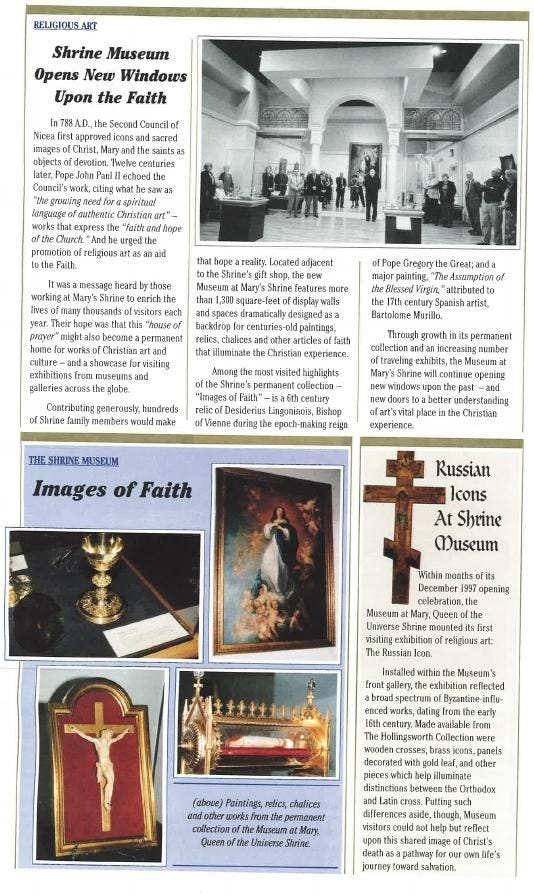
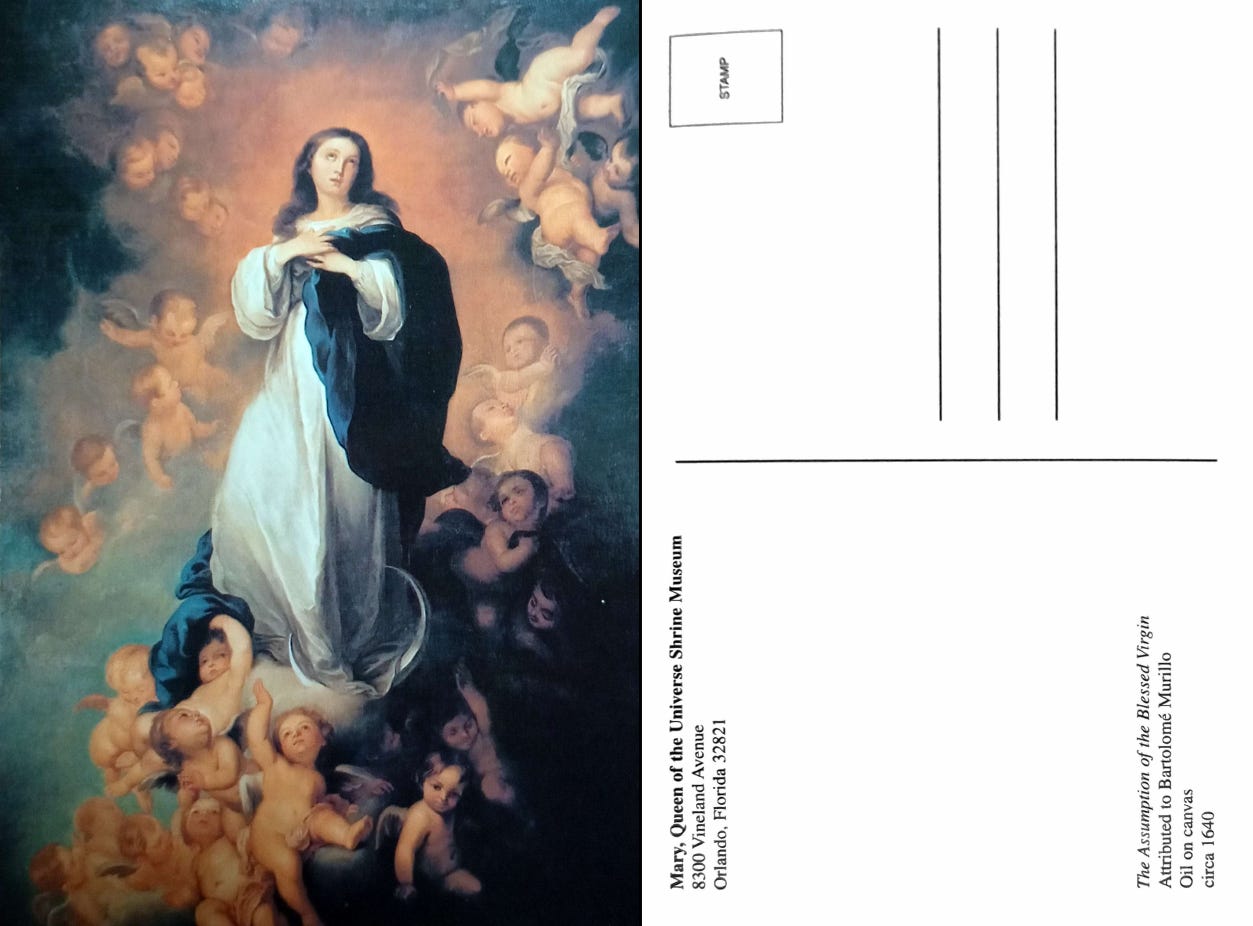
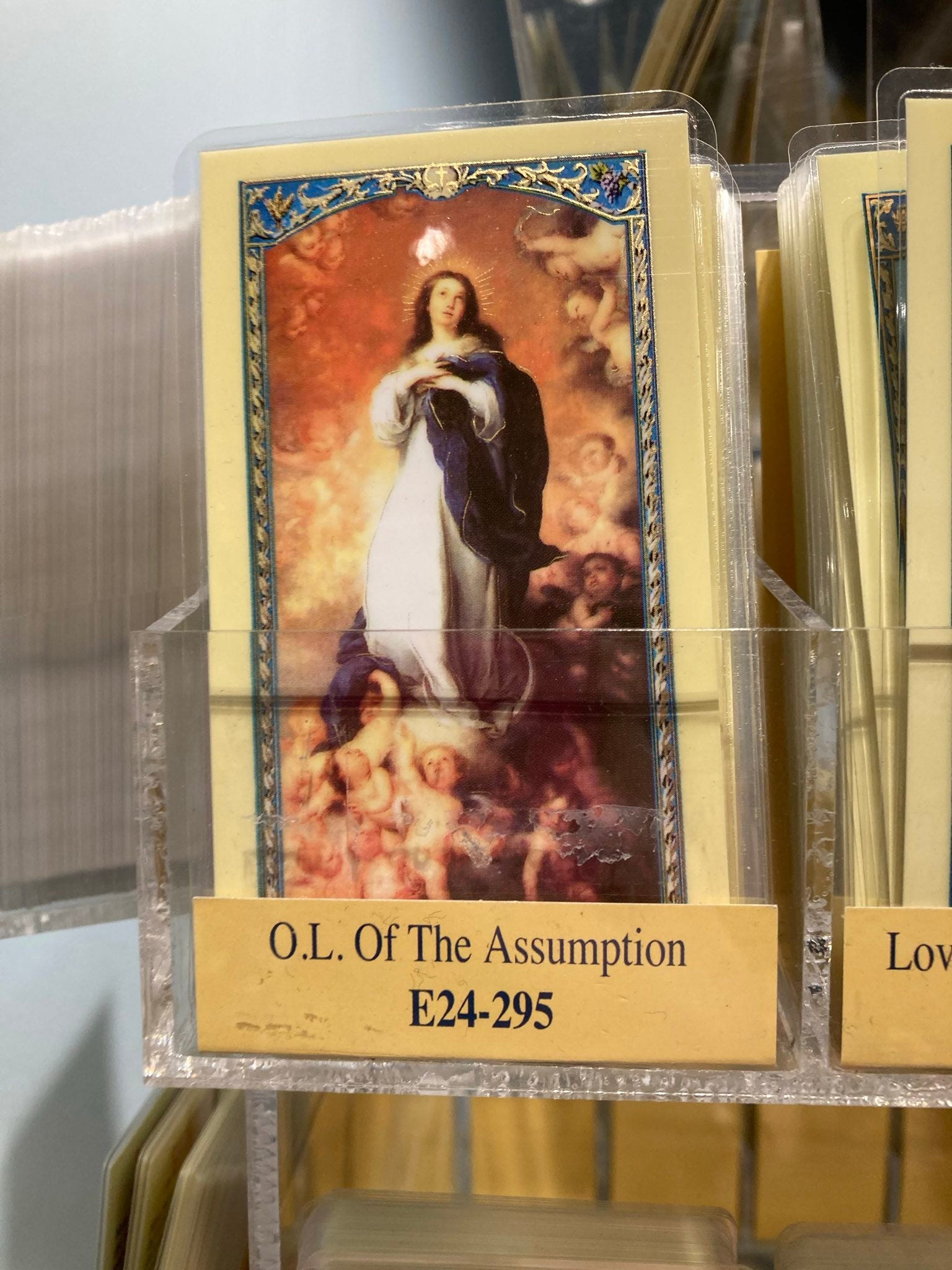
Even Pacheco addresses the Assumption separately, citing Jerónimo Nadal as a prime artist to model. Among the hundreds of Assumption paintings out there, I would also recommend the multiple versions by Guido Reni, Peter Paul Rubens and Juan de Valdés Leal. I hope one day the correction is made ensuring both the staff and visitors of the Shrine can truly appreciate the treasure they have in their midst.